AndMicrosoft has the ability to bill for Copilot per user. Agentforce is available to be charged by Salesforce for each conversation. Intercom allows to bill Fin for results. The one change provides a lot of insight into where B2B SaaS growth is going in 2026.
It used to be simpler to describe the old SaaS playbook. Be more aggressive on seats, annual contracts, some premium bells and whistles, and let customers success reduce the churn after. AI has made that model more a hassle. A more difficult question to answer is now posed to the founder. Is the customer paying for access to the product, activity, or measurable business value?
This isn’t a hypothetical scenario any longer.
If AI is integrated into products, there is a change in the cost structure. A select few users use the AI aspect of the tool to the tiniest extent. Others operate very robust systems, all day long. Some customers prefer a set rate, rather than the variable rate system. There are those who wish to pay after the AI addresses a support issue, builds a workflow or saves man hours.
I don’t believe that this is a temporary price trend. It’s a re-working of the business model.
Why B2B SaaS growth now depends on pricing discipline
The worst sentence for SaaS is one that I read recently, “We will introduce AI and we will charge more.”
That seems fair as long as you consider the price aspect. AI functions can bring in different costs that regular SaaS groups aren’t accustomed to.Normal SaaS groups are not accustomed to dealing with variable expenses introduced by AI functions. The feature is behind many things such as model usage, retrieval systems, data pipelines, monitoring, customer support, security review, and compliance checks. There is a button for the customer to see. A vendor has an input list of costs.A vendor has an input list of costs.
AI adoption is already happening to some degree across most organisations, with only a small number reporting significant financial returns and a greater number scaling AI throughout the enterprise, revealed McKinsey’s research into the state of AI 2025. That gap matters. Everyone wants to purchase AI solutions, but ROI is also on their mind.
Here lies a very costly opportunity for a SaaS firm to ERR.
An AI feature can be a powerful addition to a product team. Marketing can make it a high dollar extra. It can be given away as a productivity unlock by Sales. However, if there is no correlation between pricing and usage, the vendor risks scaring customers with bills that are harder to predict or at worst, is at risk to lose their margin by undercharging power users.
Both of these have an adverse impact on growth.
There are some SaaS companies in 2026, who will not just ask the question “Can we monetize AI?” They will pose the questions of what kinds of customer behaviors create cost, what behaviors create value, and what kind of pricing model makes the customer feel like it’s a good deal and the company feels like it’s a good deal?
There’s a more grown up one there.
It’s also the issue investors, CFOs and enterprise purchasers are beginning to be involved with.
Real World Example
See how big software firms are already on the move.
Microsoft has a straightforward seat based licensing approach with enterprise pricing at $30 per user per month, on an annual basis. That’s logical for a broad knowledge workers group as finance departments do know how much software costs per user.
There is another logic used by Salesforce for Agentforce. Some plans have its public pricing in Agentforce’s case, it’s 2 dollars per conversation. That model is more suitable to customer facing automation as it would cost would be based on the number of services.
The other way is on display at Intercom’s Fin. Fin offers 0.99 dollars outcome. Not everything is about a price model of “pay for AI access.” It is more of “pays when useful result is produced by AI”.
Zendesk has also made strides in moving toward an outcome based AI agent pricing model, which bases the commercial model just on successful resolution and not on seats or raw usage.
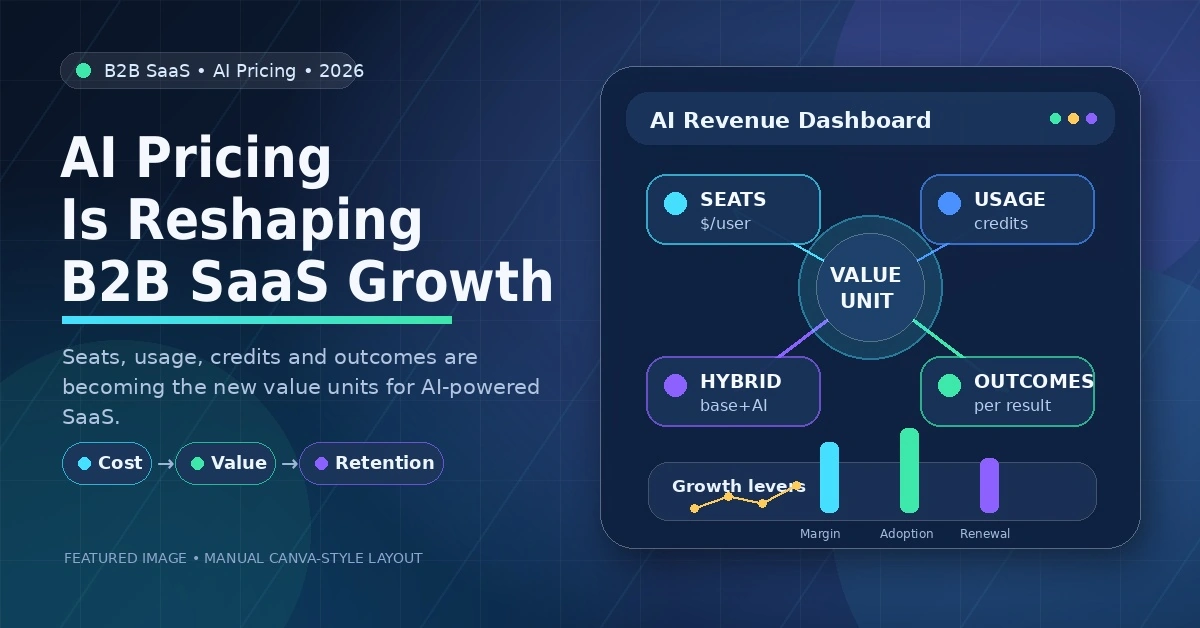
There is a definite pattern that can be seen in these examples. SaaS pricing is undergoing a transformation and is becoming ‘layered’ due to the influence of AI. Subscription base, usage limits, outcome pricing, credits, add on, and human support cost are a few of the components that can be included in one product.
This may seem like a complicated thing. Sometimes it is.
However, the complexity comes from the fact that AI is different from other facets of a normal dashboard. It is really shipped with delivery costs. Has variable uses. Has the ability to generate measurable business outcomes. It can also pose risk when the customer is not aware of the service they gets.
That’s why I believe that SaaS pricing pages will move away from “plans” and towards “value units” in 2026.
The value unit can be a user, a conversation, an answer, an action, a workflow or a credit. The winning model is one that the customer is able to comprehend, and the vendor can justify.

The four AI pricing models buyers will compare
There are two types of pricing, the first one is priced based on seats. This is still applicable in cases where the AI feature is utilized on a large team on a daily basis. It can easily be purchased, easily predicted and easily understood on the inside. The problem is evident, two users can be equally weak even if one of them relies on AI to a minimum extent and the other relies on it for most of the work.
The second type of pricing is the usage based pricing. The API products, workflows, document processing, and AI systems that cost more as they use the API are perfectly suited to this. This helps protect vendor margins, but may cause customers to get jittery. Nobody wants an unexpected invoice, particularly if you don’t have budgeted for it within the finance team.
The third one is a hybrid of pricing. I believe this is the most used answer of B2B SaaS. The vendor maintains a stable subscription tier, and include usage or credits for costly AI tasks. A stable base price is provided to the customers. Heavy usage is protected for the vendors. It does not have all the fancy features, but it’s functional.
The fourth is the outcomes pricing. This is the most intriguing and challenging to implement. The customer pays for the AI agent’s successful completion of a support ticket, workflow or verified business result. It is well appreciated by consumers. Vendors love them! The difficulty is measuring the challenge. What success means is defined as.? Who verifies it? How do you deal with situations if the customer does not agree?
Last question is no trifling matter.
The only way outcome pricing works is where both parties know what the outcome will be, it’s measurable, and they both believe in the outcome. “Improved productivity” is a difficult measurement to make, compared to a solved support conversation. The reality of a verified workflow completion is more easily priced than is “better employee experience.”
That’s where some care needs to be taken by a founder.
Take your pricing model based on what it sounds like, not because it’s modern. Select it because of matching value creation of your product and cost behaviour.
“Customers are not just buying a product; they are buying the promise of value realization.”
That’s the true move of SaaS, according to Gartner analyst, Daniel Hawkyard. The buyer of the software doesn’t want to buy another AI button. They want evidence to show that the product can ‘get them work done faster’, mitigate risk, keep customers, and/or generate increased revenue.
That’s the place the place where lots of SaaS groups fail.
They attempt to make them pay for the AI function before the customer has benefitted from it. Then they ask, “Why is expansion weak, why is adoption so slow, why do we get defensive dialog about renewal?Then they ask, “Why is expansion weak, why is adoption so slow, why do we get defensive dialog about renewal?
Value realization is not something that AI takes the place of. Makes it more noticeable.
Customer success is becoming the engine of B2B SaaS growth
In the past, a lot of people referred to customer success as a retention function. In many businesses, it involved bringing new hires on board, annual business meetings, appointment reminders, and pseudo scientific health scores, among other things.
This isn’t sufficient anymore.
When it comes to AI pricing, the opportunity to demonstrate its customer success is in 2026. In the absence of customer uptake, it’s irrelevant how you charge for the service. Even though the customer takes it up, they are unable to measure value, the renewal is still jeopardized. Expansion is even more difficult if the value is created through the AI feature, and the pricing is not felt to be fair.
According to Forrester’s thinking, customer success metrics are adoption, value realization, retention, expansion, churn and customer lifetime value. This is the correct viewpoint for SaaS leaders as it links the usage of products with revenue.
It’s important to remember that the best SaaS companies will employ the use of AI to enhance the customer journey long before they resort to AI as a paid application.
Which translates to quicker user onboarding, easier to comprehend complex product setups, be able to discover the correct workflow, less support friction, and getting to the first meaningful outcome quicker, with the assistance of AI. With many B2B products, that’s more important than the features.
It’s easier to retain a customer who has experienced value after week one, than to wait six weeks for him/her to find value.
That’s why I would prefer a SaaS company to invest in this AI and cut down the time to value than to build another AI tool that looks good on our demo and goes away after the initial deployment.
You Can Also Get More Info Here: Best B2B SaaS Software for Modern Businesses
Customer success is where the AI proposition separates to become revenue or churn.
Real World Case Study
Anthropic’s support story with Intercom is an interesting one as it relates to AI support, scale, and customer experience in an actual software environment.
According to Intercom’s customer story, Anthropic has used Fin and attained a resolution rate of 50.8 percent within the span of about a month. It also said that 96 percent of the conversations participated in and over 1,700 hours were saved in the first month.
This isn’t some sort of support automation fact. Demonstrates how AI can safeguard a rapidly expanding software business without overwhelming them with customer interactions, yet still maintain user friendly customer support.
The lesson that Synthesia provides is even more pronounced.
Fin’s customer story states that Synthesia’s customer support has increased from 40,000 to 316,000 contacts every month in four months. This is 690 per cent more. The business estimated that without AI and automation they would have been able to deal with it only with a team of 150 people in support. Rather, it maintained the same number of employees and cuts the resolution time by 96 percent.
It’s interesting not just for the winning.
The message there is that AI support wasn’t a magic bullet for the shoddy operation. Synthesia needed to enhance its information base and help process, allowing the AI to reply greater. That’s the part that many founders overlook when they come up with the idea of AI as a straight efficiency.
AI is no solution to poor foundation of customer success. Exposes them at a greater rate.
The agent will restate outdated information if the help center is out-of-date. If the process is confusing, the same will be replicated by the AI assistant in a more refined manner. When price is not known, AI may help decrease tickets but it won’t help decrease buyer anxiety.
Hence, I believe that Customer Success is the fuel that powers the monetization of AI.
Expert Insight
One of the most important revenue retention and account growth factors, one of which Shari Srebnick, of Forrester, has raised in her SaaS boardrooms, is time to value.
That’s an easy to understand insight, but a game changer for the AI roadmap.
When it comes to time to value, it’s possible the most buzzed about AI product launch isn’t the best one. It could be the one that assists a new user during setup, data connectivity, workflow explanation, or to get a meaningful result without having to wait for a customer success manager.
The type of AI is not as glitzy. It is also of higher value.
A founder can request additional costs for each of the AI functionalities. The customer success leader can resist and argue that some AI should be part of it since it enables faster activation of the users. Both can be right. The challenge is to identify which of the AI capabilities generate revenue down the road that stem from today’s retention.
That, is the deal.
The best thing that you can get out of the AI can sometimes be the one that you don’t monetize directly. It is the one which prolongs the customer for longer to expand.

The mistake SaaS founders are still making
The worst thing I’ve seen with regards to AI pricing conversations is addressing every customer as a single economic entity.
They are not.
A seat based model could make sense for an enterprise customer that has 2,000 seats and monitoring is in place. The customer might seem like a cheap contract, but AI intensive customer may be costing you a lot in the backend. Customers with low seat count, but high automation for their customer service calls might require outcome pricing. Consider a customer who has complex compliance requirements who has moderate usage, he could be charged a higher service cost.
Founders are led astray by this.
But when the usage of AI is very different, average revenue per (account) isn’t enough. There’s the fact that average cost per customer fails to reveal the margin consumers who consume a lot of your costs.
What would be better is to categorize the customers according to their value pattern.
Some customers employ AI to boost their productivity within their businesses. Few are using it for automation for their customers. Some employ it for workflows that heavily use data. Others use it from time to time, but demand enterprise grade security and support.
This Article Also Might Be Very Helpful For You: Why Most SaaS Rollouts Fail And How to Fix It
The pricing logic of these segments should not necessarily be the same.
The ideal pricing model that is beneficial for both sides. The customer needs to know the product that they are paying for. It would be helpful to the vendor to have an understanding of what type of behavior results in cost. If either side has a lack of understanding, there will be an issue at renewal.
All that frictional cost can be avoided.
What the AI cost stack really includes
Many SaaS teams have the misconception that AI cost is just about the cost of the AI model. That is too narrow.
While the actual cost stack begins with the cost of the models, that doesn’t end there. Retrieval infrastructure and vector search, secure connectors, monitoring, human review, evaluation systems, fallback models, compliance support, and improved documentation might be required.
The other side of this coin is responsibility, as customer facing AI more closely brings the technology to the people. Even with an AI support agent providing incorrect responses, there could still be a need for a human team to clean up the issue. When the AI bot gets the question wrong for billing, then the support team could be in for an angry customer. The legal risk can become greater than the saving provided by the support, if the information provided by the AI is incorrect with respect to the policy or contract detail.
That’s why it’s important that the ROI math is straight forward.
A weak ROI model states that there are 30 minutes that each support rep could save if they used AI.
A better question is, did that time saving result in a decrease in hires, faster resolution, increased customer satisfaction, decreased churn, gross margin protection or creation of revenue from expansion?
When it’s not clear what the answer is, then the ROI is not proven.
Some of the research from McKinley’s research on AI is helpful here as it gives some insight into how much AI is applied, and how much financial return is being achieved. There are numerous companies out there using AI, but not many that can show impressive enterprise level financial return.
That should make SaaS leaders less than the optimists, it should make the leaders disciplined.
There is real value to be created by the use of AI. However, the value should be based on some sort of business metric not just some demo moment.
A practical way to price AI without hurting retention
I would begin with one of the problems of customers, not with one of the AI features.
Select workflows that have an impact on retention/exansion. Onboarding is good There’s also support resolution. Therefore, it is possible to have renewal risk detection work as well. It’s all about the beginning of value measurement.
Then, determine if the AI functionality is as an add on, a meterable option or a premium add on.
If it’s a feature that will help all users reach a value quicker, then it could be part of the base product and help to retain users. Usage based or credit based pricing might be more suitable if it has a high variable cost. When the feature delivers a definite outcome, there’s a chance of trying outcome based pricing.
Once the success measurement is defined, the next one is to determine the success threshold prior to launch.
That could be the first time to value when it comes to onboarding. Some helpful metrics that can be used on the support level could be cost per resolution, automated resolution rate or first contact resolution. Gross, net, or expansion ARR are some of the metrics that could be used to measure customer success.
Next, conduct a pilot that incorporates a small group of customers.
Don’t roll out a price increase for all customers based on a successful test of the AI functionality. Begin with a single segment, value metric, and a commercial hypothesis.
A SaaS company, for instance, may experiment to determine if they can lower the rate of customers churning in the first 90 days to discover whether an AI onboarding assistant has a beneficial effect on their new SMB customer retention. One could try and find out if the use of an AI support agent can save the business on cost per resolution for high volume accounts while maintaining satisfaction. A third experiment could be conducted to see if renewal risk summaries led to more revenue being saved by customer success managers over at risk bills.
Useful Pricing Work this is what that is!
It’s nothing sexy like a new tier, but it’s rather more probable to outlast the renewal season.
How customer success teams should change in 2026
Whether or not a Customer Success team should be an AI engineer might not be the right question, but becoming more data literate should be.
They must be able to understand what features users are using that are provided by AI, where users become frustrated, what accounts are benefiting from the measurable benefits of AI and which accounts are paying for AI without using it. The latter is a group that is hazardous. While they may seem to be performing well on the revenue sheet, they are churn risk waiting to happen!
Customer success team should also be the conduit of customer feedback for pricing.
Pricing feedback means if customers find the AI feature to be helpful, but the billing is still somewhat unexpected, then there is some pricing feedback. Product Feedback. If the customers find the feature of the AI interesting but it doesn’t directly have an impact on their business, then it’s Product Feedback. If customers state that they are not able to articulate the value to their CFO then that’s a message that has been fed back.
All of this should NOT be left in customer success notes.
It should find it way to the product, pricing, finance and sales.
It’s in this place that B2B SaaS businesses could benefit. Churn risk will be detected sooner for the firms that will be able to tie use of AI to customer success workflows. They will be familiar with the characteristics that are important for growth. They will be able to determine the cost of AI that’s worth taking on and which needs to be monetized.
This is a good overview if you are looking to tie this into a larger enterprise AI plan, Enterprise AI agents in 2026. Governance and permission design. On the pricing end, it also aligns well with cloud cost optimisation for 2026 as the cloud workload becomes more of a burden on infrastructure margins due to the introduction of AI workloads.

The counterintuitive truth about AI monetization
The logical one might seem to be that SaaS businesses should rapidly start to collect fees for AI services.
Sometimes they should.
The surprising thing is that, rather than directly addressing monetization, the first use case of AI in SaaS could well be to enhance retention. If there is a feature that helps reduce churn, it’s more valuable than a feature that adds a little extra to the bill that customers may not feel they’re getting a value for.
This is particularly true in the very busy SaaS classes.
Then if other competitors are using AI, and buyers are using AI for their products they will look for it if they don’t pay for it separately.Other competitors might have incorporated AI into their products, and buyers might be expecting to hear about AI as a part of their products as well so selling separately too early may create resistance. However, if the artificial intelligence capability brings in high costs or definite, measurable results, it may be damaging to margins to give it away.
There is no one size fits all!
You Can Also Get More Info Here: 10 Best B2B SaaS Tools for Enterprise Teams (2026)
That’s why it’s important to have a pricing discussion that begins with customer value, customer cost behavior and impact to customer retention. Having those as individual departments is where companies get a smart AI capability which no one can accurately price.
FAQs
What is changing in B2B SaaS pricing in 2026?
B2B SaaS pricing is shifting from simple seat-based subscriptions toward layered models that combine seats, usage, credits, and outcomes. AI features create variable costs, so vendors need pricing that protects margin while still feeling fair to customers.
Why does customer success matter more for SaaS companies using AI?
Customer success proves whether AI is creating real value after the sale. If customers do not adopt the AI feature, reach value faster, or connect it to a business outcome, the feature may look impressive but fail to improve retention or expansion.
Is outcome-based pricing better than seat-based pricing?
Outcome-based pricing can be better when the result is easy to verify, such as an automated support resolution. Seat-based pricing is still useful when AI is used broadly across daily workflows. The best model depends on the product, cost structure, and customer expectations.
How should a SaaS founder start pricing AI features?
A founder should start with one workflow, define the business outcome, estimate the real cost stack, and test pricing with one customer segment. The goal is to prove value before applying a broad pricing change across the whole customer base.
Conclusion
B2B SaaS growth in 2026 will not come from adding AI features alone. It will come from pricing those features honestly, connecting them to customer success, and proving value before renewal conversations become uncomfortable.
The companies that win will not be the loudest AI marketers. They will be the ones that know which AI features reduce churn, which ones deserve premium pricing, which ones protect gross margin, and which ones help customers reach value faster.
My advice is simple. Before you ask how much to charge for AI, ask what business result the customer can prove after using it.
That answer should shape the pricing page.
Author Bio
Talha Qureshi is an enterprise technology analyst and blogger with over a decade of hands-on experience across cybersecurity, cloud infrastructure, B2B SaaS, and enterprise AI. He writes about the gap between how enterprise technology is marketed and how it actually performs in real organizational environments.