Skip to content
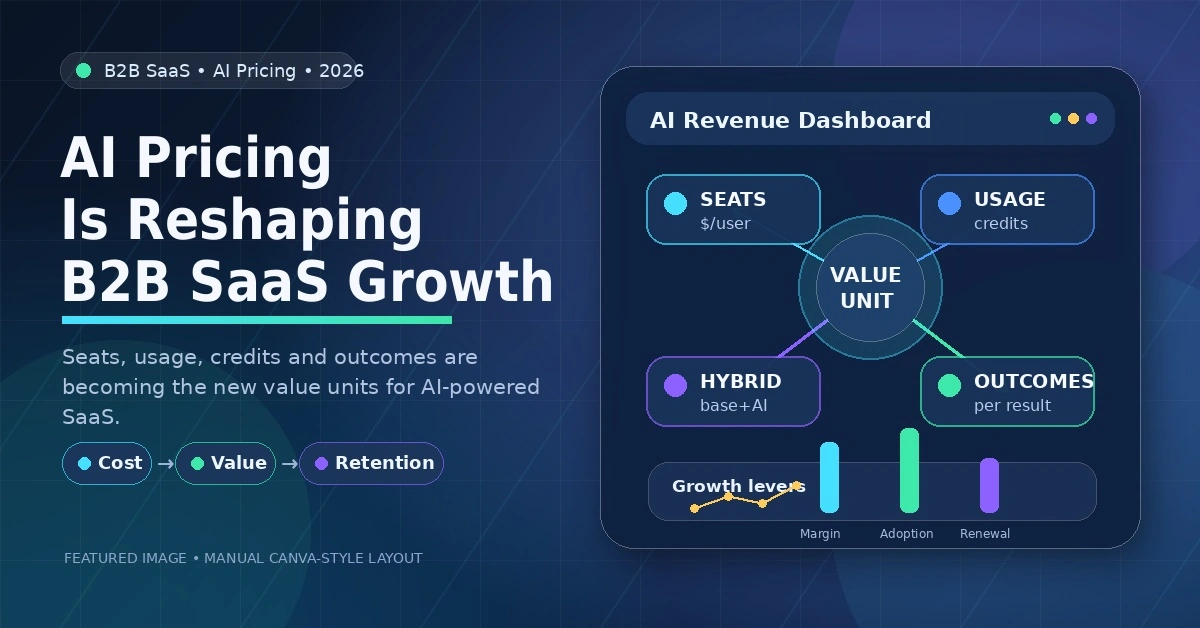
AI is changing B2B SaaS economics in a way that ordinary feature expansion did not. Traditional software can serve another user at relatively low marginal cost, while an AI-heavy workflow may create new variable costs every time a model runs, an agent calls a tool, a document is retrieved or a task is retried.
That does not mean the SaaS model is disappearing. It means growth teams need a tighter connection between customer value, pricing, AI cost, adoption and retention. A product can grow usage while weakening gross margin, or add impressive AI features without improving the customer’s business outcome.
The AI SaaS Unit Economics Loop
A useful growth framework is to evaluate five connected questions in sequence:
- Value unit: What customer outcome or activity creates measurable value?
- Cost unit: What does it cost the SaaS company to deliver that activity?
- Pricing unit: What billing model aligns revenue with value without creating unacceptable uncertainty?
- Adoption unit: Can the customer reach useful results quickly enough to keep using the product?
- Expansion unit: Does greater use create healthy retention and expansion rather than support burden or margin erosion?
The loop matters because optimizing only one variable can create problems elsewhere. Aggressive usage pricing may protect margin but discourage adoption. Unlimited AI may accelerate activation but produce uncontrolled compute costs.
AI Changes the Cost Structure of SaaS
For conventional SaaS, the largest costs may include cloud infrastructure, support, sales and product development. AI adds another variable layer. Depending on the architecture, a single customer task may involve model inference, embeddings, retrieval, external APIs, tool calls, storage and repeated attempts before a successful result.
Build an AI cost stack
| Cost layer | What to measure |
|---|---|
| Model inference | Input, output and reasoning consumption by workflow |
| Retrieval | Indexing, embeddings, vector search and document processing |
| Tools and APIs | Paid external calls triggered by agents or workflows |
| Compute and storage | Application infrastructure, databases, logs and generated artifacts |
| Retries and failures | Cost of tasks that do not produce an accepted result |
| Human review | Operational time required to validate or correct output |
| Support | Tickets, onboarding and troubleshooting created by AI features |
This produces a more useful number than model price alone: cost per successful customer outcome.
Per-Seat Pricing Is Not Dead, but It Is No Longer Enough for Every Product
Per-seat pricing remains sensible when value strongly correlates with the number of people using the application. AI creates cases where that relationship becomes weaker. One user may run a large volume of automated work, while another may use the product lightly. An autonomous workflow may also create value without a person actively sitting in the interface.
That is why B2B SaaS companies increasingly need to test pricing architecture rather than assume one model fits every feature.
Four pricing models to evaluate
- Seat-based: predictable and familiar, best when user access remains the primary value driver.
- Usage-based: revenue scales with consumption such as tasks, credits, records or compute, but customer bills can become harder to forecast.
- Hybrid: a platform or seat fee includes an allowance, with additional usage priced separately.
- Outcome-linked: pricing references a completed business result. This can align value strongly but requires precise definitions, attribution and protection against disputes.
A hybrid model is often easier to introduce because it preserves predictable recurring revenue while exposing unusually expensive AI consumption. The right choice still depends on what customers actually value and what the vendor can measure reliably.
For a broader view of SaaS buying models, see the ITechTrove guide to B2B SaaS software.
Use a Value Unit Before Choosing a Pricing Unit
Pricing becomes fragile when the billable metric is convenient for the vendor but disconnected from customer value. Tokens are a good example. They may matter internally for cost management, but most buyers do not purchase tokens as a business outcome.
A stronger process is:
- Map the workflow the product improves.
- Identify the unit customers recognize as useful, such as resolved cases, qualified opportunities, processed documents or completed analyses.
- Measure how AI cost changes as that unit scales.
- Select a pricing metric that is understandable, measurable and economically sustainable.
The billable unit does not have to equal the internal cost unit, but the company should understand the relationship between them.
Gross Margin Needs Workflow-Level Visibility
Company-wide gross margin can hide an AI feature that becomes less profitable as customers use it more. Finance and product teams should be able to estimate contribution margin at the workflow or feature level.
A simple operating equation is:
AI workflow contribution = revenue attributable to the workflow minus model cost, tool and infrastructure cost, and human review and support cost.
The equation is not a formal accounting standard. It is a management lens for finding products where adoption and economics are moving in opposite directions.
Watch for these margin warning signs
- Power users generate much higher AI cost without corresponding expansion revenue.
- Retries or long contexts increase faster than successful task completion.
- Support teams spend substantial time correcting misunderstood AI behavior.
- New model upgrades improve quality but materially increase cost per task.
- Free or bundled AI features are becoming a primary infrastructure expense.
Customer Success Is Now Part of AI Product Quality
AI features can appear easy to demonstrate but difficult to operationalize. A customer may understand a chatbot in minutes while still struggling to connect data, define permissions, validate outputs and change internal processes. That gap between demo value and operational value is where retention risk grows.
The first customer-success goal should be time to verified value, not simply time to first login. A useful onboarding plan identifies the first repeatable workflow the customer can complete successfully and safely.
Measure customer success around outcomes
- Time from contract start to first accepted business outcome.
- Percentage of target users completing the core workflow.
- Frequency of successful repeat use.
- Human correction or escalation rate.
- Expansion into adjacent workflows after the first use case is stable.
- Reasons customers disable or bypass AI features.
This is particularly important because weak implementation can create the same adoption problems discussed in the ITechTrove analysis of why SaaS rollouts fail.
Do Not Confuse AI Usage With Product-Market Fit
High AI activity may indicate curiosity, repeated failures or inefficient workflows rather than durable value. Product teams should distinguish between consumption and successful completion.
For example, a user generating ten versions of a report could signal enthusiastic exploration, or it could mean the first nine outputs were unusable. The metric that matters is not generation volume alone. It is whether the user achieved the intended result with acceptable quality, time and cost.
Build Pricing Experiments Around Segments
Large enterprises, small businesses and specialist teams may have different preferences for predictability, control and usage exposure. Instead of making one site-wide pricing change, test pricing architecture against clearly defined segments.
| Segment signal | Pricing question |
|---|---|
| Stable user count, moderate AI use | Would seat or platform pricing remain simplest? |
| Few users, very high automation volume | Should usage be separated from seats? |
| Large enterprise with strict budgeting | Would committed usage with overage controls reduce uncertainty? |
| Workflow with measurable financial outcome | Can value-linked pricing be defined without attribution disputes? |
Record not only conversion rate but also gross margin, usage distribution, expansion, support burden and churn signals after the change.
AI Defensibility Is Broader Than Model Access
Most SaaS companies can access capable foundation models. The durable advantage therefore rarely comes from simply adding the same model to an existing interface. Defensibility can come from a combination of workflow depth, proprietary or permissioned data, integrations, distribution, trust and the ability to deliver a reliable outcome.
The SaaS AI Defensibility Stack
- Workflow ownership: the product is embedded in a recurring business process.
- Data advantage: it has lawful access to context that improves the task.
- Integration depth: it connects securely to the systems where work happens.
- Evaluation quality: the company can measure whether AI output is actually useful.
- Trust and governance: buyers can understand access, privacy, controls and accountability.
- Distribution: the vendor can acquire and expand customers efficiently.
This is a stronger moat than generic AI functionality alone.
A Quarterly AI SaaS Growth Review
Leadership should review AI product economics and customer value together rather than in separate finance, product and customer-success meetings.
- Which workflows created the most customer value?
- Which workflows produced the highest variable AI cost?
- Did successful usage lead to retention or expansion?
- Which customer segments exceeded included usage?
- Where did human review remain necessary?
- Are pricing limits understandable before customers receive the bill?
- Which AI features are strategically important but economically weak?
For teams evaluating multiple products, ITechTrove’s B2B SaaS tools guide can help frame broader software-selection considerations.
How to Grow B2B SaaS Without Sacrificing Margins
Sustainable B2B SaaS growth comes from increasing customer value and retention while keeping acquisition cost, support effort and infrastructure cost under control. Teams should track net revenue retention, gross margin, customer acquisition payback and cost per successful workflow—not just new subscriptions. AI features add variable inference and tool-use costs, so measure them at the workflow level and compare the result with your core SaaS economics. Our guide to how AI is changing SaaS pricing and unit economics explains the product and margin trade-offs.
Conclusion
B2B SaaS growth in 2026 is not simply about adding AI faster than competitors. Sustainable growth requires an economic system in which customer value, pricing and delivery cost move together.
The strongest AI SaaS companies will know the cost of a successful workflow, price around a value unit customers understand, shorten time to verified value and treat retention as evidence that the AI feature is useful in practice. Growth without those controls can increase revenue, usage and complexity at the same time while weakening the underlying business.
For a related long-term cost risk, see how SaaS vendor lock-in affects operating costs when renewal, data portability and exit decisions are made.