Skip to content
A SaaS data export can preserve a surprising amount of information while still failing to preserve the business context that made the information useful. Text, messages, attachments and database rows may survive, but relationships between records, permissions, live calculations, workflow state and the path from discussion to decision can be harder to reconstruct. The practical question is not only whether the data can be exported, but whether another team could understand and rebuild the work from what the export contains.
Files Are Only One Layer of Recoverability
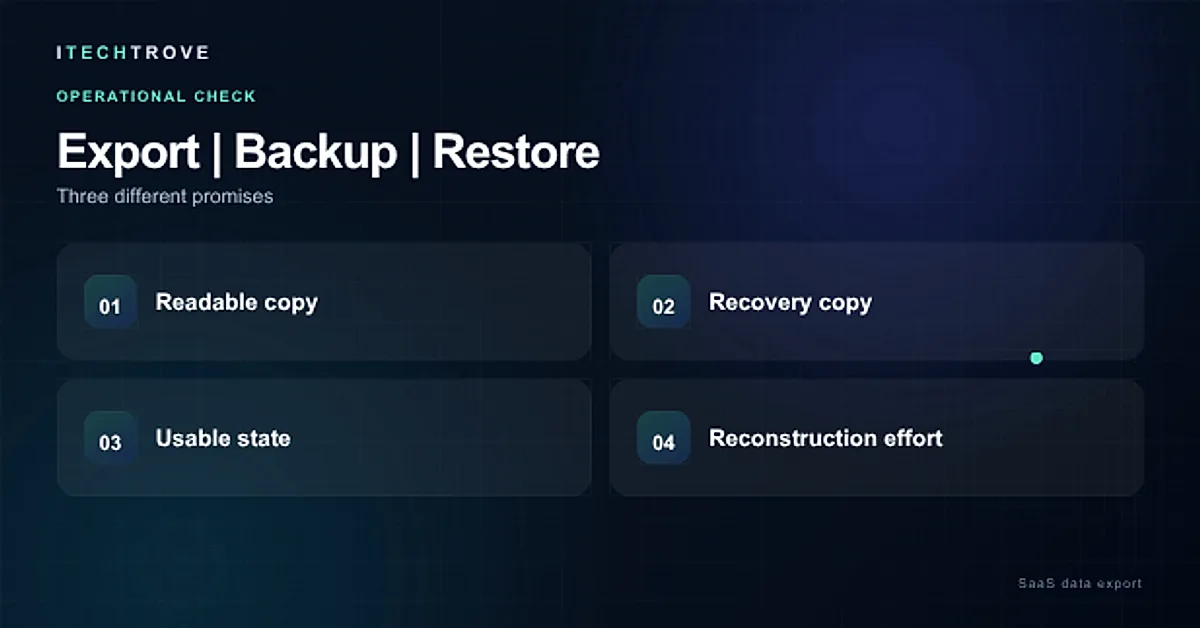
Teams often use backup, export and restore as if they mean the same thing. They do not. An export is a representation of data. A backup is a copy intended to protect against loss. A restore is the ability to return a system to a usable state. A portability package may be valuable even when it cannot recreate the original application.
Notion makes this distinction explicit. Its current documentation says a workspace can be exported as HTML, Markdown or CSV, with uploaded files included, but also states that an exported workspace cannot be instantly recreated by reuploading the export. Pages the exporter cannot access may be omitted. That means the export is useful, but its recoverability depends on what the team expects to rebuild.
Use a Reconstruction Matrix and Not a ZIP File Checkbox
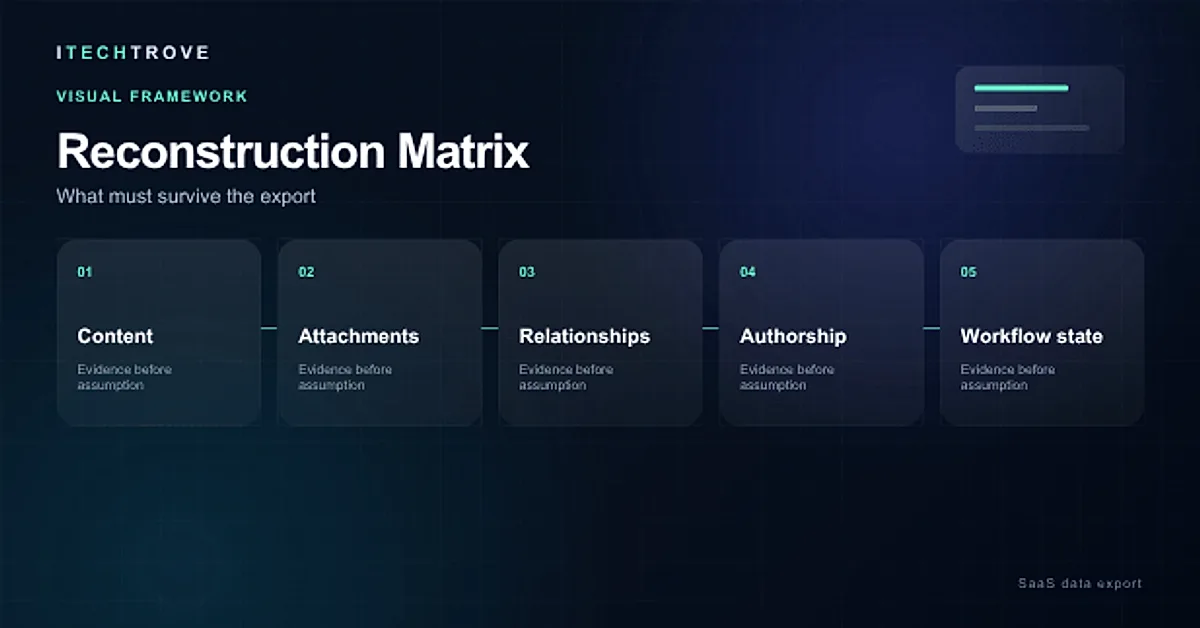
| Business element | Question to ask after export | Why it matters |
|---|---|---|
| Content | Is the text readable without the original SaaS? | Basic knowledge survival |
| Attachments | Are files included locally or only referenced by links? | Links can break after deletion or account closure |
| Relationships | Can linked records still be connected? | Relationships often carry project meaning |
| Authorship | Can you identify who wrote or approved something? | Needed for accountability and audit context |
| Timestamps | Are creation, edit and message times retained? | Reconstructs sequence and decision history |
| Permissions | Can prior access boundaries be understood? | Important for sensitive material |
| Workflow state | Are status, views, automation state and dependencies preserved? | Determines whether work can resume |
This matrix changes procurement thinking. A vendor can truthfully offer export while still leaving a customer with substantial reconstruction work. That is one reason portability should be evaluated alongside ITechTrove’s broader analysis of SaaS vendor lock in and long term operating cost.
What a Notion Export Officially Gives You
Notion’s workspace documentation says an export can include pages as HTML, Markdown or CSV and uploaded files. It also provides a sitemap to navigate exported pages. However, access matters. Private pages unavailable to the exporter may not be included, and teamspace settings can affect what leaves the workspace.
The official warning that a workspace cannot be instantly recreated from the export is important because it sets the correct expectation. An export can be a durable readable copy without being a full application state restore. Reddit users repeatedly describe learning this distinction only after attempting to reimport relational workspaces. Those reports are anecdotal, and several are mixed with promotion of third party backup tools, so they should be treated as problem signals rather than independent product benchmarks.
Slack Shows a Different Portability Problem
Slack’s export model demonstrates why every SaaS product needs its own reconstruction test. According to Slack’s export documentation, JSON exports contain conversation history plus metadata and file links. They do not necessarily contain the actual files themselves. If a referenced file, channel or workspace is later deleted, the link may no longer be usable.
Coverage also depends on plan and export authorization. Slack’s plan specific export guide distinguishes public channel exports from broader private channel and direct message exports available under particular plans and approval conditions. Slack canvases and lists have additional export behavior, including current content, some version information and references to comments or embedded files.
That does not make Slack’s export bad. It means a chat system stores business context differently from a workspace database. A fair portability review should measure the application’s actual data model, not force every product into the same checklist.
The Most Valuable Data May Be the Decision Trail
Imagine a project that ends with a one page launch plan. The final file may be preserved perfectly, while the reasons behind its decisions are spread across comments, Slack threads, database properties, approvals and attachments. If a future team needs to know why a vendor was rejected, who approved the exception or which assumption changed, the final file alone is not enough.
This is where SaaS data export becomes a governance question. Decide which information must remain intelligible after the original application is unavailable. For a low risk design board, final files may be enough. For compliance, contracts, customer commitments or operational procedures, provenance and decision history may matter just as much as content.
A Practical Export Drill Before You Depend on It
Do not wait for cancellation, an outage or an accidental deletion to inspect the export. Create a small synthetic project containing an attachment, a comment, two linked records, a status change, a restricted item and a decision with an identified author. Export it using the account and plan your organization actually has.
Then open the package without using the original application. Check whether a new team member can locate the project, identify the decision, find the attachment, understand record relationships and determine who had access. This is a proposed validation method, not a test ITechTrove has completed. Recording the results would turn a generic portability claim into evidence specific to your configuration.
The same discipline should be part of a wider B2B SaaS operating strategy. Document what business critical information lives in each platform, what can be exported, and how much manual reconstruction would follow a migration.
What to Require Before Buying or Renewing SaaS
Ask the vendor for export formats, plan restrictions, permission behavior, attachment handling, APIs and any documented restore path. Then distinguish a readable archive from a functional reconstruction. If the business depends on relationships, comments, automation state or audit history, test those objects directly rather than assuming export available covers them.
The strongest exit plan is one that has already been exercised. A ZIP file stored safely is useful. A verified understanding of what the ZIP can and cannot reconstruct is much more useful.
FAQs
Is a SaaS data export the same as a backup?
No. An export is a copy in a defined format. A backup is intended for recovery, and a restore returns usable state. Some exports are excellent archives but cannot recreate the original application structure.
Can a Notion workspace be fully restored from its standard export?
Notion’s documentation says an exported workspace cannot be instantly recreated by reuploading the exported content. Treat the export as portable data and verify separately what structure would need manual reconstruction.
Does a Slack export include the actual files?
Slack says JSON exports generally include file links rather than the workspace files themselves. Those links depend on the underlying files and workspace remaining accessible.
What should a company test before relying on a SaaS data export?
Test readable content, attachments, authorship, timestamps, relationships, permissions and workflow state. Use a small synthetic project and attempt reconstruction without depending on the live application.