Skip to content
AI meeting notes accuracy is usually strongest at capturing literal speech and weaker at preserving the operational meaning around a decision. The system can lose who owned a task, whether a decision was final or conditional, what deadline applied, and what still needed approval. A clean transcript can therefore produce a misleading record if the summary assigns the right words to the wrong speaker, turns a proposal into a commitment, or drops a condition attached to approval. For important meetings, treat the AI summary as a fast draft and verify decisions and action items against the transcript before they enter a task system.
The Failure Often Happens After the Transcript
Transcription quality matters, but it is only the first layer. A 2025 Oasis Group study, summarized by Kitces, tested six advisor-focused AI notetakers on the same scripted meeting. The tools captured key data points at roughly 85% to 96% accuracy, while action-item accuracy ranged from 62% to 87%. The study was limited to one controlled financial-advice scenario, so those figures should not be generalized to every meeting tool or workplace.
The useful lesson is narrower. A system can transcribe a conversation well and still lose accuracy when it has to infer responsibility or meaning. Kitces also noted a speaker-attribution problem in one tested tool. That matters because the wrong speaker label can cascade into the wrong task owner.
Five Places a Decision Can Change Meaning
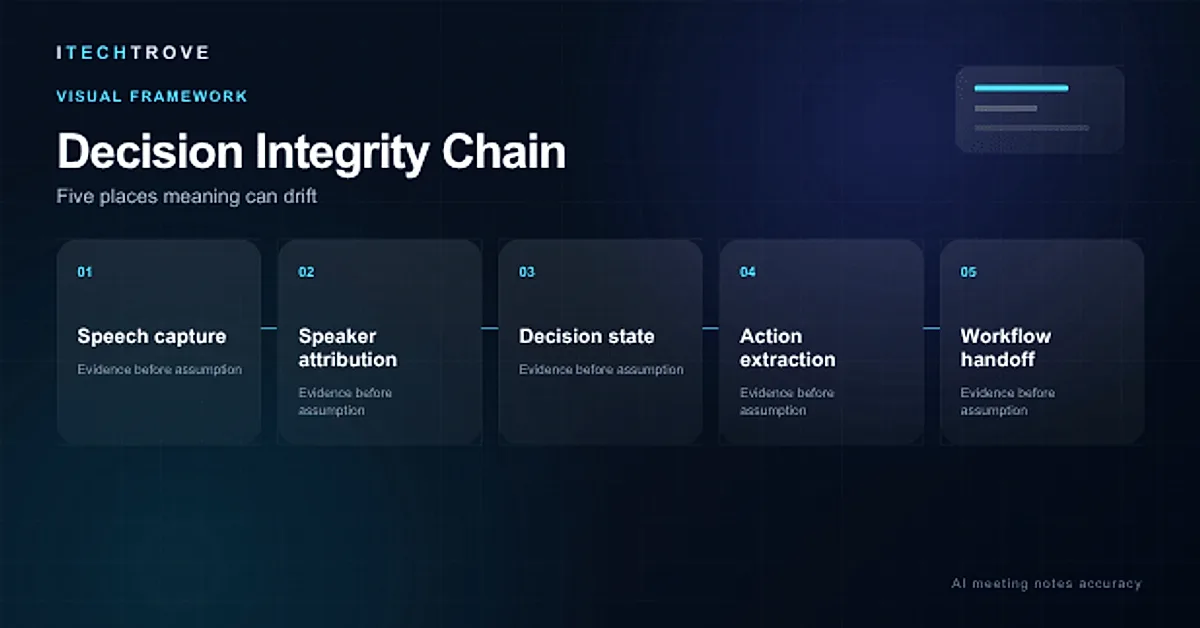
| Stage | What can go wrong | What to verify |
|---|---|---|
| Speech capture | A name, number, date, or technical term is transcribed incorrectly | Critical wording against the recording or transcript context |
| Speaker attribution | The correct sentence is attached to the wrong person | Who actually made the statement or commitment |
| Decision state | An idea, rejected option, or conditional approval is summarized as final | Approved, conditional, rejected, deferred, or still open |
| Action extraction | The task survives, but owner, due date, or dependency disappears | Task, one accountable owner, deadline, condition |
| Workflow handoff | An unchecked AI task is pushed into a CRM or project tracker | Human approval before downstream automation |
This distinction fits ITechTrove’s broader guidance on AI analytics and decision traceability. The important question is not whether an AI output sounds fluent, but whether the team can trace it back to evidence and understand what changed between source and action.
Product Documentation Shows Where Accuracy Depends on Context
Notion says its AI Meeting Notes can identify key points and action items, but its own documentation also says speaker labeling is less reliable in group meetings, shared-microphone setups, browser use, and some mobile scenarios. It explains that speaker labels are inferred from audio changes plus non-audio context such as calendar information. That means an apparently polished summary can inherit uncertainty from the attribution layer. See Notion’s AI Meeting Notes documentation.
Microsoft makes a similar limitation explicit. Its Teams recap documentation says AI-generated recap content is based on the event transcript and may occasionally be inaccurate, incomplete, or inappropriate. Zoom states that its meeting summary is generated from speech-to-text data, while Otter lets users jump from an action item back to the transcript and edit or reassign it. These product designs point to the same operating assumption. Generated notes remain reviewable artifacts, not unquestionable records.
Conditional Decisions Are Harder Than Simple Transcription
Meeting-language research has treated decision detection as a distinct problem for years. A 2007 NAACL paper, What Decisions Have You Made?, focused on automatically locating decision points in meeting conversations. Later work studied real-time decision detection in multi-party dialogue, while the QMSum benchmark emphasized that meeting summaries need to recover key decisions and tasks from long, multi-speaker discussions.
The difficulty becomes obvious with ordinary workplace language. We can ship Friday if security signs off is not the same as We will ship Friday. Alex could test the new flow is not the same as Alex will test the new flow by Thursday. A reliable meeting record has to preserve the status of the statement, not merely its topic.
What Users Report in Real Workflows
Community reports provide useful problem signals, but not measured failure rates. In one Notion discussion, a user reported host and guest identities being swapped and action items being assigned to the wrong person. In another team-use discussion, experiences were mixed. Some users described inconsistent attribution, while others reported good summaries when audio and source notes were clear.
A separate thread about tracking meeting action items repeatedly returned to the same practical fix. Move confirmed actions into a real task system, add a responsible person when the source is unclear, and avoid treating a meeting summary as the final destination.
A 90 Second Decision Integrity Check
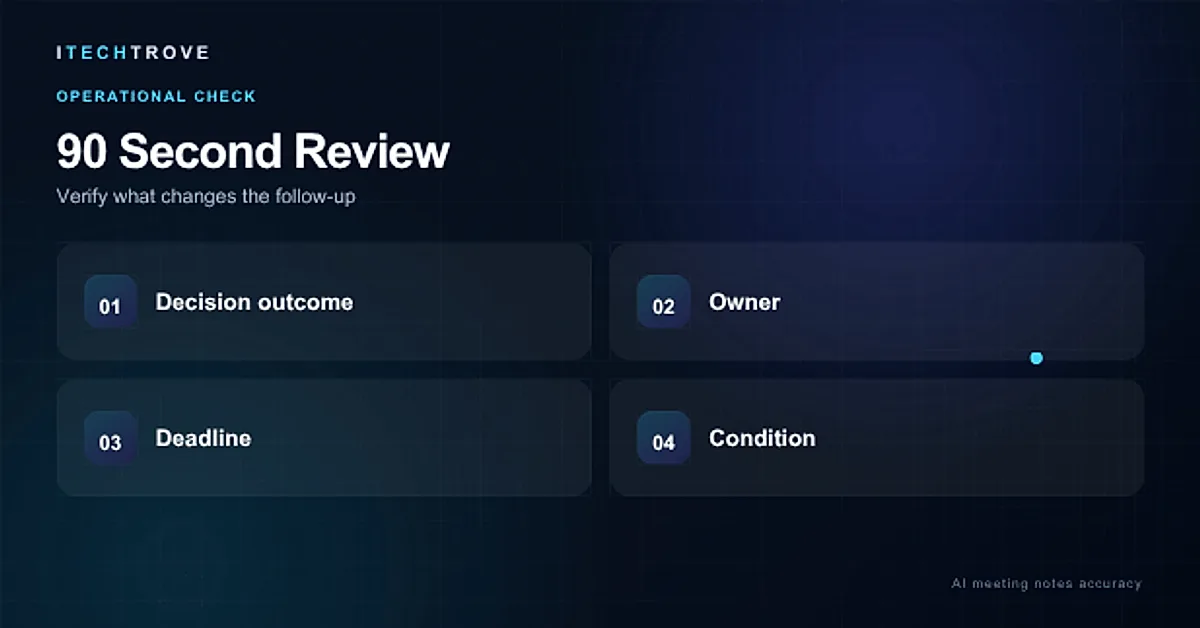
Before an AI-generated meeting note becomes an operational record, review only the fields that can materially change follow-up. For each important decision, confirm the exact outcome, its status, the owner, the deadline, and the condition or dependency. Keep a transcript citation or timestamp when the tool provides one.
Meeting-science researcher Steven Rogelberg recommends ending meetings with a short wrap-up that clarifies assignments and records what carries forward. That practice becomes even more valuable with AI notes because it creates explicit language for the system to capture. For higher-impact workflows, this also matches ITechTrove’s AI governance guidance. Human approval should be defined at the action level rather than assumed vaguely.
A practical Medium workflow from Florence de Borja reaches a similar conclusion from the user side. Separate decisions, tasks, questions, and ideas, and mark unclear owners or deadlines for confirmation instead of letting an AI fill the gap. That is process advice rather than benchmark evidence, but it is a useful safeguard.
Which Meetings Need Mandatory Human Review
Routine brainstorming notes can tolerate more uncertainty than records that trigger customer commitments, financial actions, compliance steps, hiring decisions, production changes, or automated task creation. The higher the cost of a wrong owner, wrong deadline, or false commitment, the stronger the review requirement should be.
The practical standard is simple. If someone will act because the AI says a decision was made, a person should verify that decision first. AI meeting notes can reduce documentation effort substantially. They should not quietly become the authority for what the meeting meant.
FAQs
Are AI meeting notes accurate enough to trust?
They can be useful and often highly accurate at transcription, but accuracy is not one number. Teams should separately check transcription, speaker attribution, decision status, and action-item ownership. High-impact meetings still need review.
Can AI meeting notes assign an action item to the wrong person?
Yes. Wrong speaker attribution can flow into wrong task ownership. Notion documents limitations around speaker labeling in some meeting setups, and community reports describe misassigned actions. Verify the owner before sending tasks downstream.
Why do AI meeting notes miss action items?
Action items are harder to extract when commitments are vague, ownership is implied, deadlines are missing, people interrupt each other, or a proposal is never explicitly approved. Clear meeting language improves both human and AI interpretation.
Should AI meeting notes replace manual note review?
No for consequential meetings. A better workflow is AI capture first, targeted human verification second, then task or CRM handoff. The review can be short because it focuses on decisions, owners, deadlines, and conditions rather than rewriting the entire meeting.