Skip to content
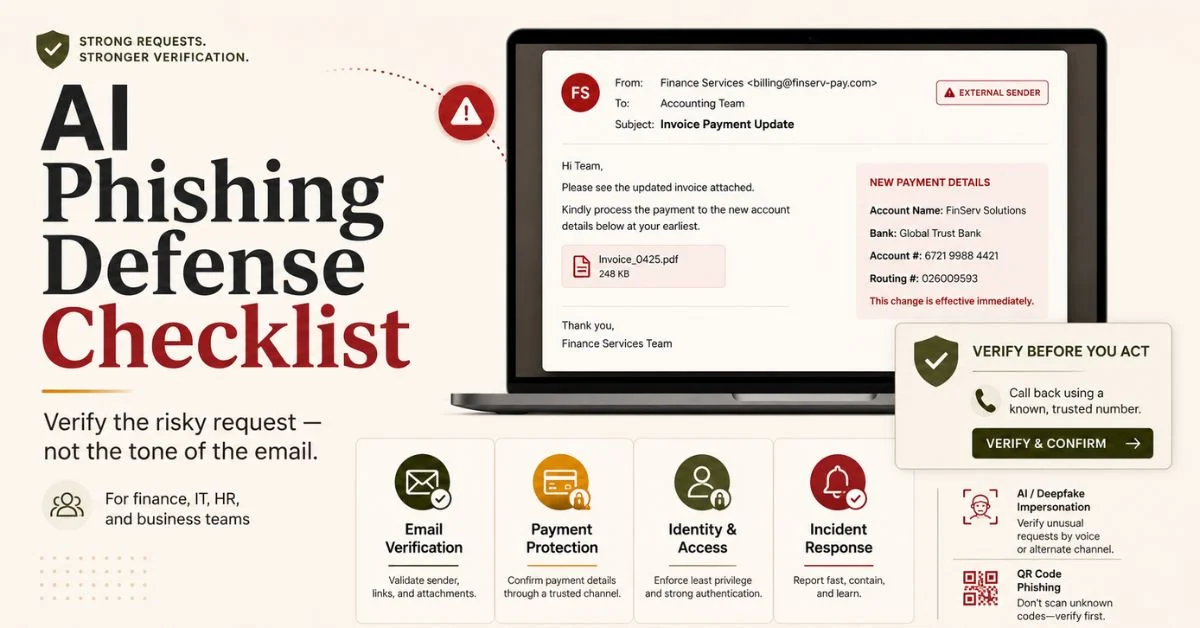
AI has made phishing easier to personalize, scale and adapt, but it has not changed the basic security problem: an attacker is trying to convince a person or system to trust the wrong identity. The most effective defense is therefore not a single detection product. It is a layered process that makes high-risk actions difficult to complete without independent verification.
This 2026 checklist is designed for business, finance, IT and security teams. It focuses on controls that reduce the chance that a convincing email, text message, QR code, phone call or synthetic voice can turn into a compromised account, fraudulent payment or data breach.
Use a Four-Layer Phishing Control Stack
A mature phishing program should combine four layers: identity protection, message authenticity, transaction verification and rapid response. If one layer fails, another should still be able to stop or limit the incident.
| Layer | Main objective | Strong control examples |
|---|---|---|
| Identity | Prevent stolen credentials from becoming account access | Phishing-resistant MFA, conditional access, privileged access controls |
| Messaging | Reduce spoofing and malicious delivery | SPF, DKIM, DMARC, secure email filtering, link and attachment analysis |
| Transactions | Stop impersonation from becoming money or data loss | Out-of-band verification, dual approval, known-contact callbacks |
| Response | Contain damage quickly | One-click reporting, session revocation, payment escalation, incident playbooks |
1. Protect Identity Before Improving Email Filters
Credential theft remains dangerous because a successful login can make later activity appear legitimate. Password-only access should not protect email, financial systems, administrator accounts or other sensitive services. Where supported, use phishing-resistant authentication such as FIDO2 security keys or passkeys rather than relying only on codes that can be relayed by an attacker.
The Cybersecurity and Infrastructure Security Agency recommends phishing-resistant MFA because it is designed to resist credential phishing and adversary-in-the-middle techniques. For higher-risk accounts, combine strong MFA with device health checks, location or risk-based conditions and shorter privileged sessions.
- Require phishing-resistant MFA for administrators, finance staff and executives where technically possible.
- Disable legacy authentication methods that bypass modern access controls.
- Use separate administrator accounts instead of giving daily user accounts standing privilege.
- Review account recovery methods so a weak recovery path cannot bypass strong MFA.
- Revoke active sessions after suspected credential theft, not only the password.
2. Treat Payment and Bank Detail Changes as High-Risk Events
Business email compromise often succeeds because the attacker does not need malware. A convincing message asking for a bank-account change can be enough. Finance teams should therefore design payment workflows so that email alone can never authorize a material change.
Control rule: any new beneficiary, bank-detail change, urgent wire request or unusual payment instruction should be verified through a second channel using contact information already held by the business. Do not call a number supplied in the suspicious message.
- Require dual approval for high-value payments.
- Use a known-contact callback for vendor bank-detail changes.
- Record who requested, verified and approved the change.
- Apply a cooling-off period to unusually large or first-time payments where practical.
- Escalate requests involving secrecy, unusual urgency or pressure to bypass process.
This control is valuable against ordinary business email compromise, AI-written messages and synthetic voice impersonation because it verifies the transaction independently of the communication channel being manipulated.
3. Configure SPF, DKIM and DMARC Correctly
Email authentication cannot stop every phishing message, but it helps receiving systems distinguish authorized senders from spoofed use of a domain. SPF defines permitted sending infrastructure, DKIM provides cryptographic message signing and DMARC tells receivers how to handle messages that fail authentication and alignment checks.
Move carefully toward an enforcement policy after monitoring legitimate senders. A rushed DMARC deployment can block real business mail if third-party systems have not been inventoried. The useful outcome is not simply publishing a DNS record. It is knowing which services are allowed to send on behalf of the organization and removing unknown senders over time.
4. Defend Against QR Phishing and Mobile-First Attacks
QR phishing can move a user away from the protected email environment and onto a personal phone, where the destination may be harder to inspect. Training should therefore cover more than suspicious links. Employees should understand that a QR code can lead to the same credential-harvesting pages as a traditional link.
- Do not authenticate to a sensitive service after scanning an unexpected QR code.
- Open important services from a saved bookmark or known application instead.
- Report QR-based login or payment requests that arrive unexpectedly.
- Use mobile threat protection where the organization has a justified risk profile and managed mobile estate.
5. Create a Deepfake and Executive-Impersonation Rule
Voice or video should not be treated as proof of identity for a high-impact business action. Synthetic media can make an urgent request sound more credible, but organizations can neutralize much of that risk by requiring process rather than intuition.
For payments, credential resets, confidential-data transfers and changes to access rights, require a predefined approval workflow. Teams may also use internal verification phrases or a separate trusted channel for exceptional events, but these should supplement, not replace, logged approvals.
6. Give Employees a Fast Reporting Path
A phishing program fails when employees are afraid to report a mistake. The reporting path should be faster than the attacker. A visible button or clearly documented channel should allow users to report suspicious messages and accidental interactions immediately.
Security teams should distinguish between reporting a suspicious message and reporting that credentials were entered, a file was opened or money was sent. The second category needs immediate incident handling. For broader defensive planning, see the ITechTrove guide to cybersecurity solutions for businesses.
7. Use the First-Hour Incident Checklist
When a phishing attempt succeeds, the first hour is usually more important than producing a perfect investigation report. The objective is containment while evidence is preserved.
- Identify the affected account and action. Determine whether credentials, tokens, files, payments or privileged access are involved.
- Revoke sessions and tokens. Changing a password may not invalidate every authenticated session.
- Reset credentials and verify MFA methods. Check whether the attacker enrolled a new factor or recovery method.
- Review mailbox and forwarding rules. Business email compromise commonly involves persistence through hidden forwarding or inbox rules.
- Search for related messages. Identify other recipients and remove malicious mail where tooling allows.
- Escalate financial fraud immediately. Contact the bank or payment provider using established channels. In the United States, relevant fraud may also be reported through the FBI Internet Crime Complaint Center.
- Preserve logs and evidence. Authentication events, message headers and endpoint activity may be needed for investigation.
8. Run a Monthly Phishing Control Review
Do not measure the program only by simulation click rate. A low click rate can look reassuring while dangerous weaknesses remain in payment approval, identity recovery or administrator access. Review operational controls instead.
| Question | Evidence to inspect |
|---|---|
| Can a password alone access a critical system? | Identity-provider policy |
| Can one person change vendor banking and release payment? | Finance approval workflow |
| Are unknown senders using the company domain? | DMARC reports and sending inventory |
| Can employees report a suspected compromise in minutes? | Reporting channel and incident metrics |
| Are privileged accounts reviewed regularly? | Access review records |
| Has the response playbook been rehearsed? | Tabletop or simulation results |
The Phishing Trust Verification Loop
A useful way to judge any suspicious request is to run it through five questions: Who is asking, what are they asking to change, what authority is required, how can the identity be independently verified, and what evidence will remain after approval? The higher the business impact, the stronger the verification should be.
This loop is deliberately technology-neutral. It continues to work as attackers adopt better language models, deepfakes and automation because the final decision depends on independent trust signals rather than how convincing the message appears.
Conclusion
AI can make phishing more polished, targeted and scalable, but businesses do not need an equally exotic defense for every new technique. The strongest protection comes from removing single points of trust. Phishing-resistant authentication protects accounts, email authentication reduces spoofing, transaction controls protect money, and rapid incident response limits damage when prevention fails.
For business teams, the practical objective is simple: no important payment, credential change, data transfer or privileged action should depend on one message, one password or one person’s judgment.