AI Readiness Audit 2026 A 50-Point Checklist Before a Business Uses AI Tools

AI isn’t to blame for the failure of a business, it’s to blame on the business.

It has been found to be unsuccessful due to the combination of strong tools with dirty data, ambiguous workflows, lax access policies, and even those who weren’t informed what they can safely upload. This is where the idea of AI as an innovation project becomes an idea of governance.

This checklist is an AI readiness guide for business owners, IT managers, operations leaders and SaaS teams looking to leverage AI but don’t want to turn the company into a live experiment. It’s not about slowing down the rate of adoption. The idea is to ensure that the business is prepared before it shares its assets like customer information, records, processes, tickets, sales, and decision-making with AI.

I get suspicious when a company begins by incorporating the tool.

The more pertinent question is, “Which AI platform should we purchase? The more interesting question is “Are we ready to use AI in a way that will benefit the job but not cause issues of security, privacy, quality and accountability?”

This is what this article will fill.

What AI Readiness Really Means for a Business

AI readiness of a business is the capacity to leverage AI safely, effectively and consistently without introducing risks that the business is not aware of and cannot manage.

On the surface this seems easy but when you get down to it, it isn’t.

It’s possible for a company to be ready from a budget standpoint but not from a data standpoint. Yet another company might have data and no employee policy. There’s likely a third company using ChatGPT, Gemini, Claude, Microsoft Copilot, or something else they’ve built internally, but no one’s reported who can use it, when it should be approved and who’s responsible if it’s inaccurate.

That’s the most important aspect of the game for most teams to miss.

IBM Report

NIST’s AI Risk Management Framework defines AI risk management as a method to enhance trustworthiness throughout the design, development, deployment and evaluation of an AI system. An IBM Report on the Cost of a Data Breach also reveals a significant oversight on AI – particularly with ungoverned AI systems and inadequate AI access controls.

Both of these notions have the same practical implication.

Having employees eagerly embrace AI is just the beginning of the steps toward AI readiness. It’s ready as soon as the company can clearly and succinctly answer dull but crucial questions.

  1. Who owns AI decisions?
  2. Which data is allowed?
  3. Which tools are approved?
  4. What happens when AI is wrong?
  5. Who reviews sensitive use cases?
  6. How is business value measured?
  7. How are security risks controlled?

Whether those answers are not clear or the company does pay for AI software it is still in the experimental phase.

The Mistake Many Companies Make Before Adopting AI

The most frequent error is to consider using AI as a subscription to a software solution.

A team gets signed up for a tool, shares it with its employees, expects to see productivity and allows experimenting. Sometimes it does. Typically, the benefits stemming from the initial investments are fragmented and challenging to quantify.

While many organizations are leveraging AI and trying out AI agents, most are still early in their AI scaling and value capture in the enterprise, according to the 2025 State of AI survey by McKinsey. The discovery should start to cause business leaders to pause. Not everyone is all ready to be an adoptive parent. Experimentation isn’t necessarily operational value.

Here is the part that is contrary to the common sense.

With clear data rules, workflows and processes, and measurable use cases, a smaller business with more gradual adoption of AI may be more prepared when compared to a larger company that is using ten AI tools.

Maturity isn’t meaning measured in speed.

Control is.

AI Governance Overview

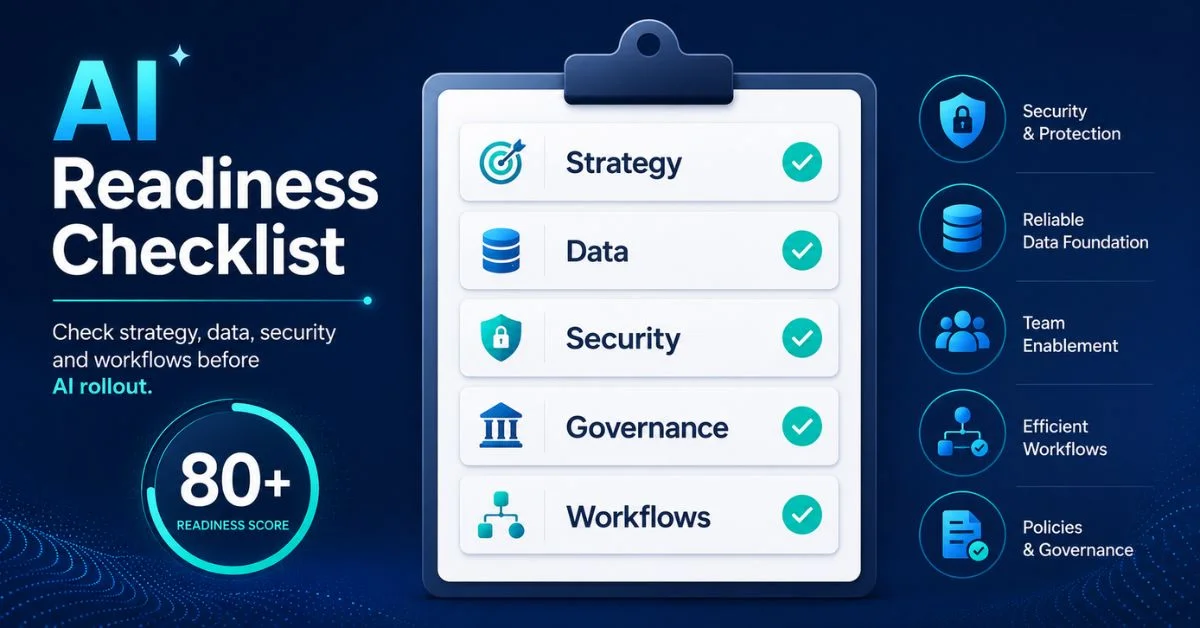
AI Readiness Checklist for Business Teams

Review the checklist below before purchasing a new AI platform, introducing new AI tools to employees, or integrating AI with internal data, business processes, and customer information.

You Can Get More Information About Tools Here: AI Analytics Tools for Decision Making

Honestly Score each item.

If business already requires the requirement then use “Ready”. And if the requirement is partially completed use “Needs work”. If the business does not have a clear process at present, then use “Not ready”.

Strategy Readiness

Readiness checkpoint Why it matters
The business has defined the main reason for using AI AI should solve a business problem, not exist as a trend project
AI use cases are ranked by value and risk Not every workflow deserves automation
Leadership agrees on what AI should not be used for Boundaries prevent misuse before it spreads
The company has a 90-day AI adoption plan Short plans are easier to execute and measure
Success metrics are defined before rollout AI value must be measured beyond excitement

Data Readiness

Readiness checkpoint Why it matters
Customer data is classified by sensitivity AI tools should not receive data the company cannot protect
Employee data has clear handling rules HR and payroll data need stricter controls
Financial data has limited AI access Finance workflows create high business risk
The company knows where important data is stored AI cannot be governed if data locations are unknown
Duplicate and outdated data is cleaned regularly Bad data produces unreliable AI output
Sensitive documents are labeled clearly Employees need visible guidance before uploading files
The business has a data retention policy AI projects should not preserve unnecessary information

Security Readiness

Readiness checkpoint Why it matters
Approved AI tools are listed internally Employees should know which tools are safe to use
Unapproved AI tools are blocked or monitored Shadow AI creates invisible risk
AI accounts use strong authentication AI tools can become access points for attackers
Admin access is limited Too many admins create unnecessary exposure
AI tool permissions are reviewed monthly Access should change when roles change
Prompt and file uploads are logged where possible Logs help investigate mistakes and incidents

Governance Readiness

Readiness checkpoint Why it matters
One person or team owns AI governance Shared responsibility often becomes no responsibility
Sensitive use cases require approval Legal, HR, finance, and customer-impacting AI need review
AI policies are written in plain language Employees follow rules they can understand
AI vendors are reviewed before purchase Vendor risk is part of AI risk
There is a process for reporting AI mistakes Problems must be visible before they become expensive
AI decisions have human accountability The tool should never become the final excuse

People and Training Readiness

Readiness checkpoint Why it matters
Employees are trained on safe AI use Most AI risk starts with everyday user behavior
Teams know what data they cannot upload Clear examples work better than vague warnings
Managers understand AI limitations Leadership must not overtrust polished output
Employees know how to verify AI answers AI can sound confident while being wrong
The company has an AI usage guide A short internal guide prevents repeated confusion

Workflow Readiness

Readiness checkpoint Why it matters
AI is attached to specific business workflows Generic access rarely creates consistent value
Each AI workflow has an owner Someone must maintain quality and accountability
Human review is required for high-impact output AI should assist decisions, not silently replace judgment
AI-generated content is reviewed before publishing Brand, legal, and factual risk need control
Customer-facing AI responses are tested Poor answers can damage trust quickly

Tool and Vendor Readiness

Readiness checkpoint Why it matters
Each AI tool has a documented purpose Tool sprawl increases cost and confusion
Pricing and usage limits are understood AI costs can grow quietly across teams
Vendor privacy terms are reviewed Data handling terms matter before upload
Export and deletion options are checked The company should know how to leave the tool
Integrations are reviewed before activation Connected tools expand the risk surface

Legal and Privacy Readiness

Readiness checkpoint Why it matters
The business understands relevant privacy duties AI use may involve customer, employee, or regulated data
Copyright risk is considered for generated content AI output should not be blindly treated as owned material
Customer consent rules are reviewed Some AI uses may require clearer disclosure
Contracts allow AI processing where relevant Vendor and client agreements can restrict data use
High-risk use cases are reviewed by counsel Some decisions should not be automated casually

Measurement Readiness

Readiness checkpoint Why it matters
Time saved is measured by workflow Productivity claims should be proven
Error rates are tracked before and after AI Faster work is not better if accuracy falls
Customer impact is monitored AI should improve experience, not only internal speed
Cost savings include tool and maintenance cost ROI must include the full operating cost
The business reviews AI performance monthly Readiness is not one-time work

This table is not meant to make AI adoption feel complicated. It is meant to make the hidden work visible.

If a business cannot score at least thirty-five of these checkpoints as “Ready” or “Needs work,” it should avoid broad AI rollout. Start with one narrow use case instead.

The Readiness Score That Actually Matters

A simple scoring model makes this easier.

Give each checkpoint a score:

  • Ready gets 2 points.
  • Needs work gets 1 point.
  • Not ready gets 0 points.
  • The maximum score is 100.

How to Read Your AI Readiness Score

If the score is greater than 80, the company is likely prepared to consider a step-by-step approach to the use of AI.

Any score between 60 and 80 indicates that the business would require to initiate limited workflows and resolve governance issues, all in one.

If the score is below 60, it should be prudent to not yet integrate AI with sensitive data or critical processes.

This score is not a legally approved certification. It’s a real management indication.

It is not a low readiness score that is the most dangerous. There is remedial action to be taken for low readiness. The most hazardous score is false confidence; when leadership feels the business is ready, simply because employees are using AI daily.

This is precisely how shadow AI turns into frequent.

How AI Readiness Fails in a Growing Business (Real World Example)

A real life scenario is as follows.

An online services provider with 40 employees moves to a new AI-powered solution that summarizes sales calls, writes customer emails, creates blog content and analyzes support tickets. Initially, all things move quicker. Time is saved by the sales team. Customer support provides a quicker response. More marketing publications.

But there are problems, then.

There has been no testing to see if customer transcripts can be added to the chosen AI. The support team adds disputes about refunds to prompts. The marketing team generates claims by using AI that is not verified. The operations manager links an AI Assistant to shared documents, and this includes financial forecasts and employee records.

You Can Also Get More Information From This Article: 5 Companies That Cut Costs 30%+ Using AI in 2026

The company didn’t suffer due to the lack of usefulness of AI.

It didn’t work because AI was beneficial enough to get around without any controls.

What a Safer Rollout Would Look Like

The rollout would begin with a practical first step by introducing three approved workflows, internal meeting summaries, non-sensitive marketing outlines, and customer support draft suggestions.

There would be no data that is sensitive included. The outputs would be the subject of review by the manager. For 30 days, the company would monitor the time saved, rates of corrections and incidents of risk before rolling out and expanding.

This is what readiness is all about.

Not perfect. Controlled.

What Most Businesses Misunderstand About AI Readiness

A lot of leaders think that being AI ready is predominantly a technical problem.

They question the company about having the right software, having the right amount of data, or a powerful model. While those questions are important, they aren’t all they are. The real question is whether the organisation can assimilate AI into the real work without compromising accountability.

Microsoft’s responsible AI approach is helpful here as it brings together responsible AI and governance, team enablement, sensitive-use review, engineering practices and compliance mechanisms. This is the area that many small businesses overlook as it is the paperwork that comes off as enterprise.

It’s not paper work!

It’s good sanitation.

There is no need to have a 90-page policy for AI to begin safely within a business. It requires clarity of rules that employees will be able to comprehend. The Requires a list of approved tools. Requires data boundaries. Requires sensitive uses to be reviewed. It requires a means to evaluate the effect of AI on work, rather than to simply do bad work quicker.

Practical Decision Framework

A Practical Decision Framework Before Approving Any AI Use Case

Before approving any AI use case, ask five questions.

What Decision or Task Will AI Support?

If it is not clear, it’s not ready for use case. Productivity is NOT a use case. A use case is an example of something a system should be able to do.Use cases are examples of things the system should be able to do.

What Data Will the Tool Touch?

Many teams go wrong in this point.

Organizations should not treat all information the same way. They need to classify and protect different types of data such as public information, internal process documents, customer records, employee information, and financial data according to their sensitivity and business value.

What Can Go Wrong If the Output Is Wrong?

An incorrect blog outline is aggravating.

There is a potential legal risk of a wrong compliance summary. A misrecommended refund can be detrimental to customer’s trust. Often the wrong security event summary will delay the response.

Who Reviews the Output?

AI shouldn’t take the place of human judgment in high-stakes situations. It should decrease the amount of manual efforts in and around it.

How Will Value Be Measured?

The use case can be interesting, even if the business will not be able to measure the value generated, such as time saved, cost reduced, error rate improved, response time improved or revenue impact.

This framework of decision is better than the question of “good” or “bad” for AI. It’s not just one but four components: workflow, data, people and risk, that dictate readiness for AI.

What to Fix This Week Before Using AI More Widely

For any business aiming to make a quick move they shouldn’t try to solve all the problems at once.

This week’s first five fixes.

Create a One-Page AI Usage Policy

Keep it simple.

Identify approved tools, data types prohibited, data types allowed and review requirements.

Make a Sensitive Data List

Add personal customer information, passwords, API keys, contracts, financial records, employee information, private client files and legal documents.

Choose Three Approved AI Use Cases

Select processes with low risk, but still save time.

Examples of this are meeting summaries, drafts of processes, ideas generated, and first draft of content that is reviewed by humans.

Assign an AI Owner

This may be someone like an IT manager, operations lead, founder or responsible head of the department. The title doesn’t really matter, what matters is the responsibility.

Review Tool Access

Get rid of old users, restrict admin level access, use strong authentication, and create a matrix of who can access what AI technology. The company is not going to become fully mature, with the completion of these five steps. They will take care to eliminate the obvious risk, as soon as they can.

That matters.

The Business Case for AI Readiness

The financial aspect of AI readiness is an aspect that needs greater focus.

When there’s poor readiness there’s cost even if it’s not obvious at first glance. Collisions of tools are charged to teams. Staff make time-consuming corrections to poor quality outputs. Managers approve AI use cases that are unlikely to generate measurable returns, while employees or systems transfer data to unauthorized sensitive locations. Once the workflow is successful, legal and security teams are able to uncover issues.

The opposite of good readiness is poor readiness.

It aids the business in selecting less number of the tools, utilizes them effectively, safeguards the data, and allows them to concentrate on the processes where the AI can provide return on investment. It is, therefore, important to not consider readiness as a hurdle. It’s the business’s way of safeguarding its return on investment in AI.

This is echoed by McKinsey’s recent survey on the state of AI in enterprises, which revealed that many companies are still in the early stages of developing and scaling AI and reaping enterprise value. Accessing AI isn’t difficult.Opening up access to AI is not difficult. What’s difficult is taking that access to a more solid business enhancement.

Generally, it involves workflow redesign, rather than simply the use of tools.

Limitations of This AI Readiness Checklist

This checklist is not meant to be a substitute for legal counsel, security evaluation, vendor due diligence or compliance audit.

Some financial services firms, government contractors, legal practices, and healthcare companies might require more stringent control as compared to a small marketing agency or ecommerce website. A company that is only using AI for their brainstorming, versus one that is integrating AI into the customer service, hiring, fraud detection, pricing or internal knowledge base equation is in a different risk category.

The checklist is not intended to be comprehensive.

It is useful in determining if there is a fundamental organizational structure to employ AI responsibly. Does not imply that all AI systems are safe, compliant, accurate or profitable.

You Can Also Get More Information About AI Here: AI Agents in 2026 Enterprise Value Risks and Adoption Guide

This can be important since AI is not equally developed. There are real-life applications which are useful. Some are overhyped. Others are dangerous as the surrounding of the tool of the process is weak.

Final Recommendation

As a business, you should not be asking yourself if you’re ready for AI, in particular.

It should query if it is ready for one particular AI workflow for one approved tool with known data, clear ownership, human review and measurable value.

That’s the Real Life Test.

If your company’s AI readiness score is above 80 on this checklist, think about implementing a slow rollout and track results on a monthly basis. If your score is in the 60-80 range, select a single low risk workflow and address the lowest scores first.

And if score is less than 60, do not embark on a wide roll-out of AI. The key is to lay the foundations first. AI isn’t going to wait until all businesses are completely developed. However, it is not brazen to use it if you are not ready. It is careless.

AI readiness is not about buying the most advanced tool. It is about knowing exactly which data, people, workflows, and risks the tool will touch before it becomes part of daily work.

Expert Insight

One of NIST’s most helpful resources for businesses is its AI Risk Management Framework, which approaches AI risk management as an organizational concern, rather than a technical one.

By highlighting risk management processes to individuals, organizations and society, it provides companies with a real perspective for considering trustworthiness, governance and evaluation beyond features of the tools.

FAQ

What Is an AI Readiness Checklist?

An AI readiness checklist helps businesses evaluate whether their data, tools, people, policies, security controls, and workflows are ready for safe and successful AI adoption.

Why Does AI Readiness Matter Before Using AI Tools?

AI readiness matters because AI tools can touch sensitive data, influence business decisions, and change workflows. Without readiness, companies risk data leaks, inaccurate outputs, wasted software costs, and unclear accountability.

What Is a Good AI Readiness Score?

A score above 80 suggests the business is ready for controlled AI adoption. Score between 60 and 80 means the company should start with limited use cases. A score below 60 means the business should fix governance, data, and security gaps first.

Should Small Businesses Use AI in 2026?

Yes, small businesses can use AI in 2026, but they should start with low-risk workflows such as meeting summaries, internal drafts, research support, and content outlines. Sensitive data and high-impact decisions need stronger controls.

Who Should Own AI Readiness Inside a Company?

AI readiness should usually be owned by a senior operations, IT, security, or business leader. The owner should coordinate tool approvals, policies, training, measurement, and risk reviews.

Author Bio

Talha Qureshi is an enterprise technology analyst and blogger with over a decade of hands-on experience across cybersecurity, cloud infrastructure, B2B SaaS, and enterprise AI. He writes about the gap between how enterprise technology is marketed and how it actually performs in real organizational environments.

Leave a Comment