Skip to content
Multi-cloud can reduce dependence on one provider, but it can also multiply cost, security work and operational complexity. Using two or three cloud providers does not automatically make an organization more resilient.
A strong multi-cloud strategy starts with a business reason for every additional cloud. It defines which workloads belong where, which capabilities must remain portable and which provider-specific services are worth accepting because they create enough value.
What Multi-Cloud Actually Means
Multi-cloud means an organization uses services from more than one public cloud provider. That can include infrastructure, managed databases, analytics, AI services, storage, identity integrations or software platforms.
It is different from hybrid cloud. Hybrid cloud normally combines public cloud with private infrastructure, on-premises systems or dedicated environments.
Many enterprises use both models at the same time. Google Cloud’s Well-Architected Framework explicitly addresses cloud, hybrid and multi-cloud environments, which reflects how common mixed architectures have become.
Google Cloud Well-Architected Framework provides current architecture guidance across those environments.
Multi-Cloud Does Not Automatically Eliminate Vendor Lock-In
An organization can spend money with three cloud providers and still be deeply locked into one of them.
Lock-in depends on dependencies, not the number of invoices. A workload may rely on a proprietary database, identity service, AI API, event system or serverless runtime that is expensive to replace.
The useful question is therefore not “Are we multi-cloud?” It is “Which dependencies would be difficult to replace, and does that difficulty create unacceptable business risk?”
Create a dependency map for critical workloads. Mark each component as:
- portable with little change
- portable with moderate engineering effort
- strongly tied to a provider-specific service
- contractually difficult to move
- data-heavy and expensive to transfer
This gives leadership a much clearer picture of actual concentration risk.
Do Not Make Every Workload Portable
Maximum portability sounds attractive but can create a lowest-common-denominator architecture.
If a managed cloud service gives a team better reliability, faster development or lower operational burden, avoiding it purely because another cloud does not offer an identical service can be a poor trade.
The smarter approach is selective portability. Keep portability where the cost of being trapped is genuinely high. Accept provider-specific services where the business benefit clearly exceeds the switching risk.
For each dependency, document an exit option. The exit plan does not need to make migration painless. It needs to make the cost, time and technical work understandable.
Choose Clouds by Workload, Not by Politics
A multi-cloud architecture becomes difficult when every team can choose any provider for any reason.
Define workload placement criteria such as:
- data residency
- latency
- existing engineering skills
- managed service availability
- security and compliance requirements
- commercial commitments
- AI or analytics requirements
- recovery architecture
- customer or partner integration
Then assign a preferred platform for each major workload type. Exceptions should be possible, but they should have a documented reason.
This prevents multi-cloud from becoming “every team does whatever it wants.”
Identity Is the First Control Plane to Standardize
Multiple clouds create multiple consoles, roles, service identities and permission models. If access is managed separately in each environment, security teams lose visibility quickly.
Use a central identity strategy where possible. Federate workforce access, enforce strong authentication and map privileged roles across providers. Service accounts and machine identities need the same attention because they often have long-lived permissions.
Review:
- who can create new cloud accounts or projects
- who can grant administrator access
- how privileged access is approved
- how dormant access is removed
- how service credentials are stored and rotated
- how emergency access is controlled
A multi-cloud strategy without an identity strategy creates unnecessary risk.
Standardize Observability Before an Incident
During an outage, teams need one operational picture even when workloads span several providers.
Define common logging, metrics, tracing and incident standards. The underlying tools do not have to be identical, but the organization needs consistent ownership, severity definitions, retention rules and escalation paths.
Without this, every cloud becomes its own operational island. A cross-cloud incident then turns into several teams comparing screenshots instead of investigating one system.
Data Movement Can Destroy the Cost Model
Moving compute is often easier than moving data.
Large datasets can create transfer charges, long migration windows, duplicate storage and synchronization complexity. Applications that constantly move data between clouds can also introduce latency and unpredictable network cost.
Before approving a cross-cloud architecture, estimate:
- how much data moves each month
- which direction it moves
- how often it is duplicated
- how long copies must be retained
- what transfer and retrieval charges apply
- what happens during a provider outage
This is especially important for AI and analytics workloads because training data, embeddings, model artifacts and logs can become large quickly.
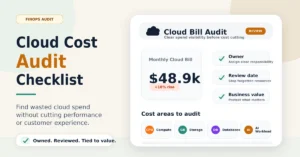
For a broader cost-control process, see our cloud cost audit checklist.
Resilience Requires Independence, Not Just Duplication
Running systems in two clouds does not guarantee that one can survive the failure of the other.
Shared dependencies can still become single points of failure. Examples include one identity provider, one DNS provider, one code pipeline, one secrets system or one data source used by both environments.
If multi-cloud is being justified as a resilience strategy, test whether the secondary environment can actually operate when the primary provider or a shared dependency is unavailable.
A realistic disaster-recovery test is more valuable than an architecture diagram showing two cloud logos.
When Multi-Cloud Is Usually Worth Considering
Multi-cloud can be justified when:
- a critical workload needs capabilities available from different providers
- regulatory or customer requirements demand specific deployment options
- the organization needs a credible exit path from a concentrated dependency
- acquisitions have created legitimate long-term cloud diversity
- a business requires provider-level disaster recovery and can afford to operate it
- different business units have materially different workload needs
When One Primary Cloud May Be Better
A single primary provider can be the smarter choice when the organization has a small platform team, simple workloads and no strong regulatory or resilience reason for another cloud.
Standardizing on one environment can reduce training, tooling, security and support overhead. The organization can still maintain exit documentation, data backups and contingency plans without operating a full second production stack.
Multi-cloud should solve a problem. It should not be adopted simply because it sounds more mature.
A Practical Multi-Cloud Governance Model
A useful operating model has four layers.
1. Shared guardrails
Set common requirements for identity, encryption, logging, network exposure, tagging, backup and incident response.
2. Workload ownership
Every production workload needs a named team responsible for cost, security and reliability.
3. Architecture exceptions
Allow provider-specific services when there is a documented benefit. Review high-risk dependencies instead of banning them automatically.
4. Regular exit reviews
For critical workloads, review whether the documented migration path still works as architecture changes.
This creates control without forcing every cloud to look identical.
Seven Questions Before Adding Another Cloud
- What problem does the additional provider solve?
- Which workload will use it?
- Who has the skills to operate it?
- How will identity and security controls stay consistent?
- What data must move between providers?
- What is the additional annual operating cost?
- How will we know the second cloud is still creating enough value one year from now?
If the business cannot answer those questions, another cloud may create more complexity than resilience.
Final Takeaway
A good multi-cloud strategy does not try to make every application run everywhere. It makes concentration risk visible, places workloads deliberately and standardizes the controls that matter across providers.
Use multiple clouds when they solve a real business, regulatory or resilience problem. Keep an exit plan for critical dependencies. Measure data-transfer and operational cost. Most importantly, make sure the organization has enough platform and security maturity to operate the architecture it is buying.
For workloads with data-residency or jurisdiction requirements, review the sovereign cloud control framework before assuming that a multi-cloud design provides the required independence.
Author
Talha Qureshi is the founder and technology writer behind ITechTrove. He covers enterprise AI, cybersecurity, cloud infrastructure, B2B SaaS and emerging technology, focusing on practical guides, analysis and source-based reporting.