Skip to content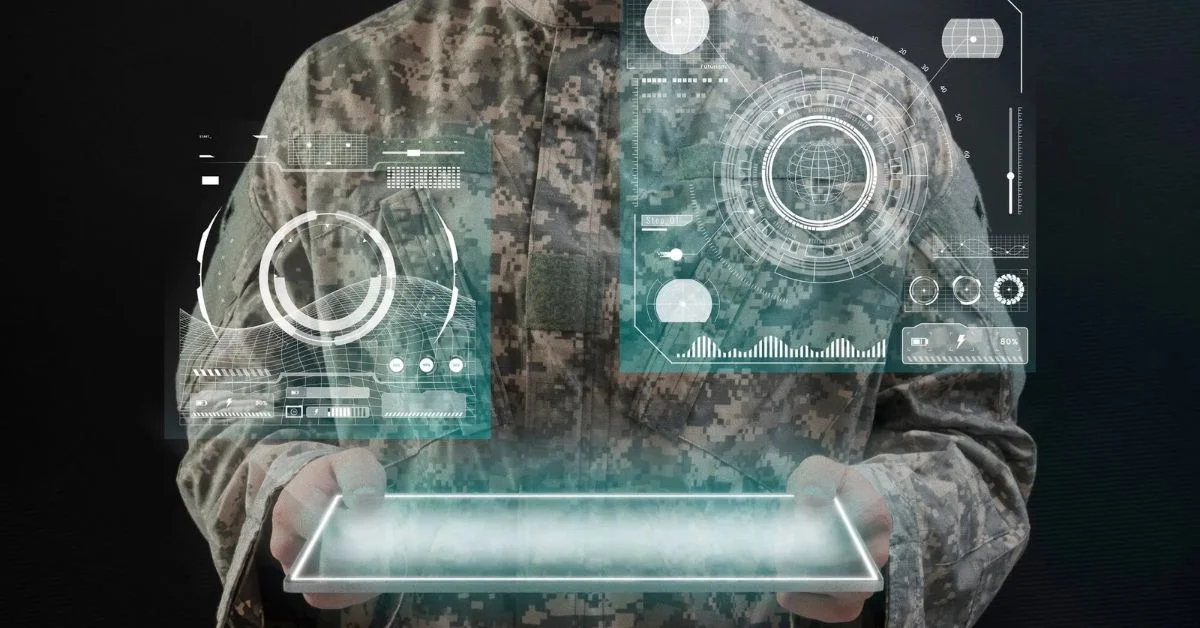
Artificial intelligence is becoming part of defense technology, but the useful question is not whether AI will suddenly “take over warfare.” The practical issue is how organizations govern systems that classify information, prioritize alerts, support planning, operate sensors, protect networks or automate parts of complex workflows. Each additional level of automation changes the failure modes, the evidence needed before deployment and the amount of human oversight required.
This article stays at a public, high-level architecture and governance level. It does not provide operational instructions for weapons or cyber attacks. The goal is to show how enterprises, contractors and public-sector technology teams can evaluate AI-enabled defense systems with the same discipline used for other safety-critical systems.
Where AI Actually Fits in Modern Defense Technology
“Defense AI” covers very different systems. Treating them as one category creates bad risk decisions. A model that summarizes maintenance records has a different consequence profile from one that influences a time-sensitive operational decision.
| Use area | Typical AI role | Primary control question |
|---|---|---|
| Intelligence analysis | Classification, prioritization, search and anomaly detection | Can analysts verify the evidence behind an output? |
| Logistics and maintenance | Forecasting demand, parts failures and maintenance needs | How is model drift detected when operating conditions change? |
| Cyber defense | Alert triage, behavior analytics and response recommendations | What actions can the system take without approval? |
| Autonomous or semi-autonomous systems | Navigation, sensing, planning or control assistance | What are the safe operating boundaries and disengagement procedures? |
| Command decision support | Data fusion, scenario comparison and prioritization | Does the interface expose uncertainty rather than hide it? |
The Critical Difference Between Automation and Authority
A system can automate work without being granted final authority. This distinction matters because the risk of an AI capability is driven not only by model accuracy, but by what the system is allowed to do when it is wrong.
The U.S. Department of Defense Directive 3000.09 requires appropriate levels of human judgment over the use of force, realistic verification and testing, cybersecurity and resilience controls, understandable human-machine interfaces, and procedures to activate and deactivate system functions. The directive also requires systems incorporating AI capabilities to align with DoD Responsible AI principles. Read DoD Directive 3000.09.
A Defense AI Assurance Stack
A useful way to evaluate an AI-enabled system is to separate assurance into six layers. A strong model at one layer does not compensate for a weak control at another.
1. Mission boundary
Define exactly what the system is designed to do, where it may operate and which decisions remain outside its authority. “Assist analysts” is too vague. A defensible boundary specifies inputs, outputs, users, permitted actions and prohibited actions.
2. Data provenance
Teams should know where training, retrieval and operational data originated; how current it is; what labeling process was used; and where adversarial manipulation or sensor error could enter the pipeline. In defense environments, an apparently precise output can still be unreliable if its evidence chain is weak.
3. Model and system evaluation
Evaluation should cover more than average benchmark accuracy. Test rare conditions, ambiguous inputs, distribution shifts, adversarial conditions, degraded sensors, missing data and conflicting evidence. The closer a system is to a consequential decision, the more important scenario-specific testing becomes.
4. Permission envelope
Document what systems, data and actions the AI can access. Read-only analysis is materially different from the ability to alter configurations, dispatch resources or trigger downstream automation. Least privilege should apply to AI systems just as it does to human accounts.
5. Human-machine interface
Operators need more than a recommendation. They need useful context: source evidence, confidence, alternative explanations, freshness of data and the consequences of accepting or rejecting the recommendation. A polished interface that hides uncertainty can create automation bias.
6. Monitoring and shutdown
Operational monitoring should detect drift, abnormal behavior, data changes and unexpected tool use. High-consequence systems also need tested fallback and disengagement procedures rather than assuming a human can improvise during a failure.
Why “Human in the Loop” Is Not Enough
Human review can become ceremonial when operators face hundreds of recommendations, very short decision windows or interfaces that present a model output as if it were certain. Governance therefore has to measure whether human oversight is meaningful.
- Decision latency: Is there enough time for a person to evaluate the recommendation?
- Evidence visibility: Can the reviewer inspect the underlying evidence?
- Override rate: Are people actually disagreeing with the system when appropriate?
- Automation bias: Do users accept suggestions simply because the model appears authoritative?
- Escalation quality: Are uncertain or conflicting cases routed to the right expertise?
Security Risks Are Different When AI Can Act
AI-enabled systems inherit ordinary security risks such as credential compromise, supply-chain weaknesses and insecure APIs. Agentic capabilities add another dimension because manipulated inputs can influence tool selection or downstream actions. The general principle from enterprise AI security still applies: the impact of a model failure increases with its permissions.
That is why sensitive deployments should isolate tools, validate outputs before execution, separate read and write privileges, log every action, and require additional approval for high-impact operations. NIST’s AI Risk Management Framework provides a broader structure for mapping, measuring and managing AI risks across the lifecycle. NIST AI Risk Management Framework.
Procurement Questions That Expose Weak Systems
Teams evaluating defense-related AI should ask for evidence, not marketing language. Useful questions include:
- Which operational conditions were represented in testing, and which were not?
- How is uncertainty communicated to users?
- What happens when inputs are missing, contradictory or adversarial?
- What privileges does the AI have, and can those privileges be reduced by role?
- How are models, prompts, retrieval sources and tool configurations versioned?
- Can investigators reconstruct why a recommendation or action occurred?
- How quickly can a model or capability be disabled without disrupting the wider system?
- What independent red-team, safety, cybersecurity and legal reviews have been completed?
A Practical Governance Model
For enterprise teams, responsible deployment can be organized around a simple sequence: mission definition → risk classification → evidence requirements → permission design → human-control design → adversarial testing → monitored deployment → periodic reauthorization.
Reauthorization is important. A model that was acceptable at launch may become unsafe after new data sources, new tools, broader permissions or changed operating conditions are introduced. Material capability changes should trigger a fresh review rather than inheriting the approval of an older version.
What Responsible AI Changes for Defense Contractors
For contractors and suppliers, AI governance is increasingly a systems-engineering issue rather than a policy document. Requirements may affect architecture, logging, test evidence, model updates, operator training, supply-chain controls and incident response. Teams that cannot reproduce what a model saw, what version ran and which action followed will struggle to demonstrate accountability.
The strongest implementation therefore treats responsible AI as an evidence system. Every important control should leave an auditable trail: requirements, test cases, model versions, approved data sources, permission changes, operator actions and incident findings.
Conclusion
AI is changing defense technology primarily by increasing the speed and scale at which data can be analyzed and workflows can be supported. That does not remove the need for human judgment, engineering discipline or legal accountability. It increases the need for them.
The most mature organizations will not measure progress by how autonomous a system appears. They will measure whether the system operates inside a clearly defined mission boundary, exposes uncertainty, limits its own permissions, survives realistic testing and leaves humans with meaningful control over consequential decisions.
Defense AI decisions also depend on who can access advanced systems and how sensitive data is protected. Related context is available in our guide to government access to advanced AI, government software platforms for national-security data, and AI analysis of satellite imagery.