Skip to content
AI knowledge base accuracy does not automatically improve because the newest policy file was uploaded most recently. In a retrieval augmented system, the correct answer should come from the version that is valid for the user’s question, but ordinary semantic retrieval may still surface an older or not yet effective policy unless version state, effective dates, deletion rules and indexing freshness are enforced. For current policy questions, the authoritative active version should win. For historical questions, the version valid at that point in time should win.
Upload Date Is Not the Same as Policy Validity
Consider two HR policies. Version 7 was uploaded on August 1 and remains effective through September 30. Version 8 was uploaded on September 20 but does not become effective until October 1. A system that simply prefers the newest upload can answer a September 25 question with a rule that is not yet in force. A system that simply deletes version 7 on upload loses the historical context needed to answer what applied before October.
The useful data model therefore needs more than a file timestamp. It should distinguish at least document identity, version, effective start, effective end, ingestion time, source modification time and active or superseded status. That is an editorial inference from established RAG lifecycle work, not a claim that every vendor implements the same schema.
Why Semantic Similarity Can Select the Wrong Version
Vector retrieval is designed to find semantically relevant text. It does not inherently understand that two nearly identical policy clauses belong to different validity periods. A June 2026 preprint on temporal validity in retrieval memory tested this problem directly. In its experimental setup, conventional RAG frequently served superseded facts when old and new facts were semantically similar. The paper proposes explicit supersession logic rather than relying on embedding similarity to infer which fact is current.
The paper is a preprint and its benchmark does not prove that a particular commercial workplace assistant will fail at the same rate. What it does establish is the underlying engineering problem. Semantic closeness and temporal validity are different dimensions.
The Source Can Be Fresh While Retrieval Is Stale
A July 2026 Oracle engineering guide on RAG index drift describes a common production failure. A source document is updated or deleted, yet old chunks or embeddings remain retrievable because the change did not propagate through the indexing lifecycle. Oracle recommends treating the source system as authoritative and reconciling source IDs, hashes, deletion markers, versions and retrieval results.
Microsoft Copilot Studio documentation shows a related operational delay from the product side. Newly uploaded SharePoint documents may not be usable until they have been indexed, and administrators can verify whether a file is appearing in SharePoint search. Microsoft also documents that knowledge source updates can require time before they are reflected in responses. The important distinction is simple. A file existing and an assistant retrieving the correct version are separate facts.
A Five State Policy Lifecycle Is Safer Than Newest File Wins
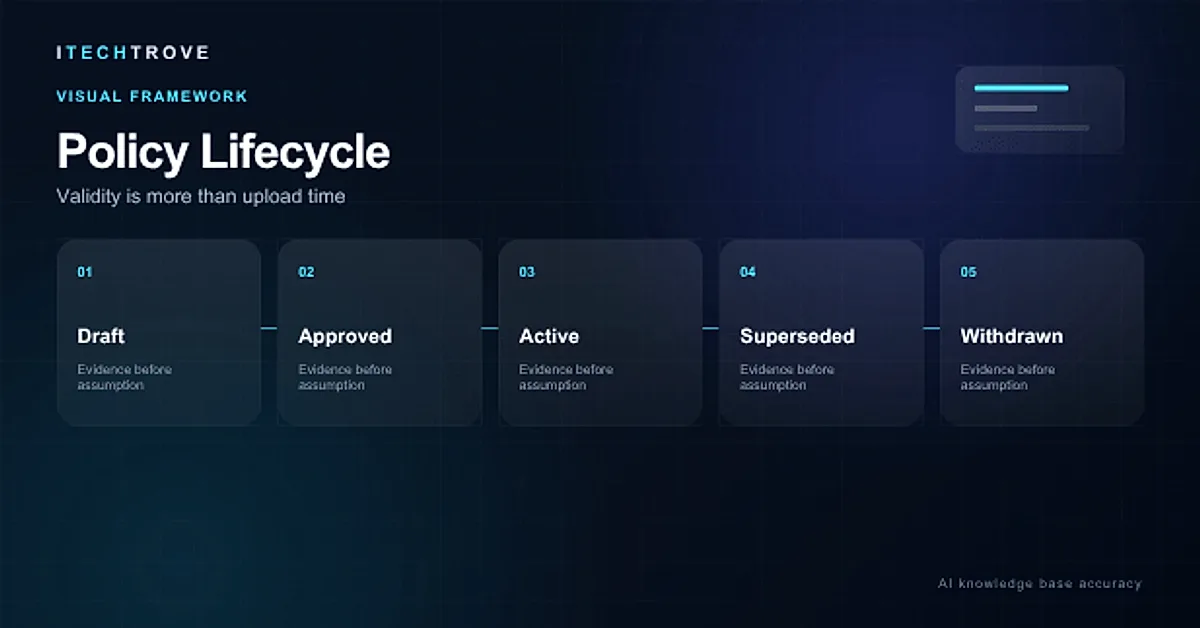
| State | Meaning | Default retrieval behavior |
|---|---|---|
| Draft | Content is being prepared | Exclude from normal answers |
| Approved | Approved but not yet effective | Exclude from current policy answers unless future policy is requested |
| Active | Currently authoritative | Prefer for current questions |
| Superseded | No longer current | Exclude from current answers but retain for historical queries |
| Withdrawn | Invalidated or removed | Exclude unless an audit or historical request explicitly requires it |
This structure turns policy validity into a controlled retrieval rule instead of asking the language model to guess from wording or filenames. It also creates a usable audit trail when someone later asks why an answer cited a particular version.
Community Reports Show What Split Truth Looks Like
Reddit discussions provide useful problem reports, not population level evidence. In one 2026 RAG thread, a practitioner described updated source documents coexisting with older indexed chunks, causing the assistant to cite rules weeks behind the source. Another LocalLLaMA post described a recruiting system where a vector store surfaced an older resume while the structured database held newer candidate information. Both accounts are self reported, but they illustrate the same failure class. Two parts of the system can hold different versions of reality.
Medium practitioners writing about production RAG repeatedly recommend version metadata, effective dates and explicit supersession. That advice is consistent with the Oracle lifecycle guidance, although individual Medium case studies should not be treated as vendor independent benchmarks without reproducible evidence.
Test the Answer and Not Just the Ingestion Job
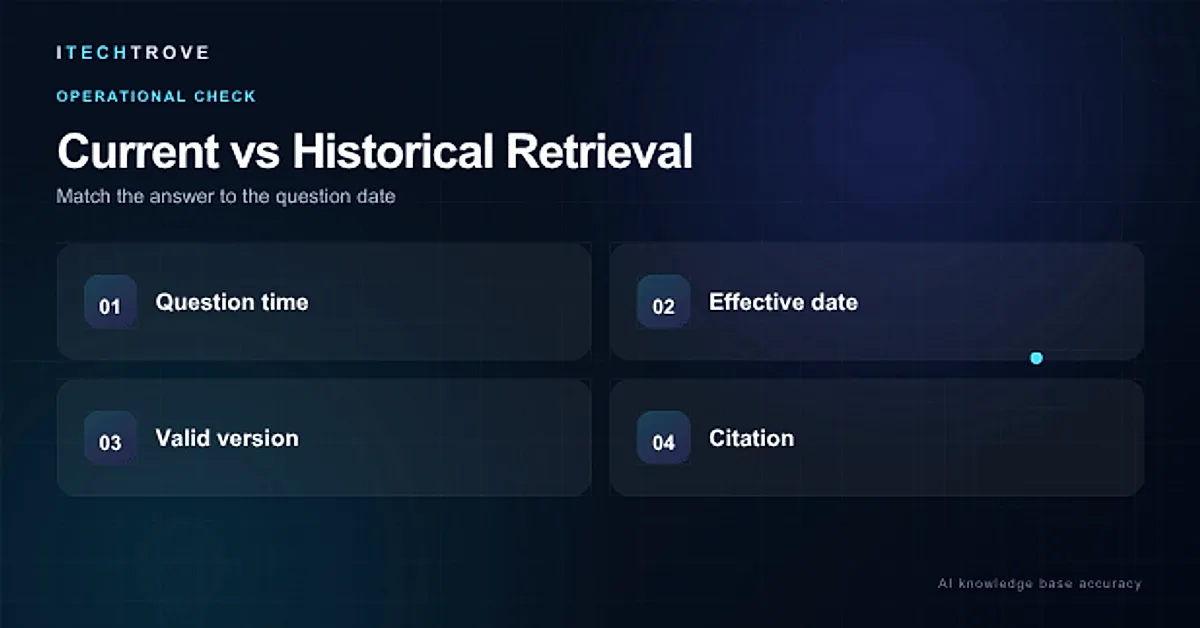
A green ingestion dashboard does not prove AI knowledge base accuracy. A practical evaluation set should contain questions designed to expose version conflicts. Ask for the rule before a policy change, the current rule after activation, the future rule before its effective date, and a withdrawn rule that should no longer appear in ordinary answers. Then inspect both the answer and the cited source version.
For each test, record query time, expected version, retrieved version, effective dates and citation. This connects directly to ITechTrove’s existing guidance on decision traceability in AI analytics. A useful answer should remain traceable to the evidence that justified it.
What Enterprises Should Require From an Internal AI Assistant
The safest operating rule is not always use the latest file. It is use the version valid for the question’s time context. Teams should define one authoritative source, propagate version changes into retrieval, retain historical versions where required, and make the active version machine readable through metadata rather than buried in prose.
High impact policy assistants should also expose citations and version information to the user. If two active documents genuinely conflict, the system should surface that conflict or abstain rather than silently choosing whichever chunk ranked higher. This fits ITechTrove’s broader enterprise AI governance model, where important AI actions need explicit ownership, review and evidence.
FAQs
Should an AI knowledge base always use the newest uploaded document?
No. The newest upload may be a future policy, a draft, or a replacement that has not completed indexing. Retrieval should use the authoritative version valid for the time period in the question.
Why can an AI assistant cite an old policy after the file was updated?
The source may be updated while old chunks, embeddings, caches or search indexes remain active. This is often called retrieval or index drift. Version reconciliation and retrieval tests are needed to verify the change propagated.
Should old policy versions be deleted from a RAG system?
Not necessarily. Historical versions can be necessary for audits or questions about past decisions. A better design is to mark them superseded and exclude them from current policy retrieval unless the query explicitly asks about the historical period.
How do you test AI knowledge base accuracy after a policy change?
Use challenge questions that distinguish the old, current and future versions. Verify the exact version retrieved, the effective date, the answer, and the citation. Include deletion and supersession cases rather than testing only ordinary current state questions.