Skip to content
Cloud cost overruns usually do not begin with one huge mistake. They build through dozens of small control failures: resources with no owner, temporary environments that never shut down, discounts bought against the wrong baseline, duplicated services across teams, and forecasts built from last month’s bill instead of next quarter’s business plan.
The cloud makes infrastructure faster to consume. That is the point. But the same flexibility also means spending can grow before finance, engineering and product leaders agree on who owns it.
The strongest response is not a blanket cost-cutting program. It is governance that connects every meaningful cloud cost to an owner, a business driver and an operating decision.
The Cloud Cost Control Loop
ITechTrove uses a simple five-part model to explain where poor cloud governance turns into financial waste:
| Control | Question | What happens when it fails |
|---|---|---|
| Allocate | Who owns this cost? | Spend becomes unaccountable |
| Explain | What business driver created it? | Teams cannot distinguish growth from waste |
| Forecast | What should happen next? | Budgets become historical guesses |
| Optimize | What can be changed safely? | Idle and oversized resources persist |
| Enforce | What guardrail prevents recurrence? | The same waste returns next month |
A mature FinOps practice keeps all five controls connected. If a company optimizes without allocation, savings are temporary. If it forecasts without explaining the underlying drivers, the model breaks when product usage changes. If it enforces rules without understanding workload needs, engineering teams route around them.
Cost allocation is the foundation
The FinOps Foundation defines allocation as assigning technology costs to the teams, products, departments or other groups responsible for them. Accounts, subscriptions, projects, tags and labels are common mechanisms.
That sounds basic, but it changes the quality of every later decision. A bill that says “compute increased 18%” is weak information. A bill that says “checkout API production compute increased because order volume rose while cost per transaction stayed flat” tells a business story.
The FinOps Framework allocation guidance is a useful reference for designing this layer.
A practical allocation policy should require at least:
- business unit or product
- environment
- service owner
- cost center
- lifecycle or expiry information for temporary resources
Do not rely on tags alone where the cloud provider’s account structure can enforce ownership more reliably. Tags are metadata, not governance by themselves.

Separate growth cost from waste cost
One reason cloud conversations become unproductive is that every increase is treated as overspending.
That is wrong. If customer traffic doubles, some infrastructure cost should increase. The better metric is often a unit cost such as cost per transaction, active customer, API call, workload, order or gigabyte processed.
This creates a useful distinction:
Growth cost is spend that increases because the business is doing more useful work.
Waste cost is spend that rises without a corresponding increase in business value, resilience or required performance.
A governance review should ask both questions. “Did the bill increase?” is less useful than “Did unit economics deteriorate?”
Idle resources are a lifecycle problem
Unused resources are often described as an optimization failure. More accurately, they are frequently a lifecycle-governance failure.
A development environment gets created for a project. The project ends. Nobody has authority to delete the environment because ownership is unclear. The resource remains live for months.
The fix is to attach lifecycle controls when the resource is created. Temporary assets should have an owner, expected expiry date and cleanup rule. Non-production environments should have documented operating hours where technically appropriate. Orphaned storage, snapshots, IP addresses, load balancers and old databases should be reviewed on a recurring schedule.
The key is to make cleanup part of provisioning rather than a quarterly scavenger hunt.
Commitment discounts can create a second kind of waste
Reserved capacity, savings plans and committed-use discounts can reduce unit prices for predictable workloads. They can also lock a company into a spending pattern that no longer matches demand.
Before making a long commitment, separate workloads into three groups:
- stable base load that is consistently consumed
- variable growth load that should remain flexible
- experimental load that should not be used to justify long-term commitments
Buying discounts against total current usage can be dangerous if a large part of that usage is temporary, oversized or about to be re-architected.
Forecast from drivers, not invoices
A forecast based only on recent spend assumes the future will look like the past. Cloud systems rarely behave that neatly.
The FinOps Foundation’s current forecasting guidance recommends combining historical spending with planned changes, lifecycle events, pricing details and business objectives. FinOps forecasting guidance specifically treats forecasting as a model that should be updated as architecture and business plans change.
A stronger cloud forecast should include driver assumptions such as:
- customer or transaction growth
- new product launches
- regional expansion
- data retention changes
- planned migrations
- new AI or analytics workloads
- contract and discount changes
- decommissioning dates
Forecast variance then becomes useful. If actual spend moves outside an agreed range, the team should know which driver changed.
Multi-cloud does not fix governance
Using more than one provider can reduce some concentration risks or meet specific product, regulatory or technical needs. It can also multiply billing models, discount structures, tagging systems, identity patterns and operational tooling.
If a company cannot allocate and explain costs in one cloud, adding a second cloud usually increases the governance problem.
Before expanding, define a common cost taxonomy across providers. Decide how products, environments, owners and shared services will be represented consistently. Without that layer, “multi-cloud visibility” becomes several dashboards rather than one operating model.
Shared services need an explicit allocation rule
Central networking, observability, security, data platforms and platform engineering often serve many teams. If these costs remain in a central bucket, product-level economics become misleading.
There is no universal allocation method. Some shared costs may be split by usage, others by revenue, headcount, workload count or an agreed fixed ratio. The important point is to choose a method, document it and apply it consistently.
A slightly imperfect allocation rule is usually more useful than leaving a growing pool of “shared” spend that nobody owns.
Build guardrails where waste begins
Governance is strongest when it changes the default behavior.
Useful guardrails include:
- approved instance families for common workloads
- budget alerts tied to owners
- mandatory ownership metadata
- automatic shutdown schedules for eligible non-production systems
- quotas for expensive services
- policy checks before public exposure or high-cost deployment
- approval rules for unusually large capacity changes
The goal is not to make engineering submit a ticket for every resource. It is to automate the safe path and make expensive exceptions visible.

A monthly governance review that is actually useful
Avoid a meeting that only reads the bill aloud. A better review answers five questions:
- Which products or teams drove the largest change?
- Which changes were expected business growth?
- Where did unit cost deteriorate?
- Which resources have no clear owner or lifecycle?
- Which control should change so the same issue does not recur?
That last question matters most. A cost optimization team that repeatedly deletes the same class of waste is treating symptoms. Governance changes the system that keeps producing it.
Final takeaway
Poor cloud governance causes cost overruns because flexible infrastructure is being consumed without equally flexible financial controls.
The solution is not simply to spend less. Allocate costs clearly, connect them to business drivers, forecast from planned change, optimize unit economics, and build guardrails into provisioning and lifecycle management.
When every material cloud cost has an owner, a reason and an expected future state, cloud spending becomes much easier to manage without slowing the teams that depend on it.
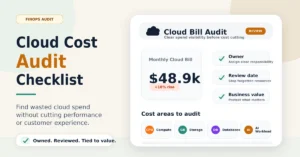
Cloud governance becomes measurable when ownership, forecasts and cost reviews share the same controls. Use the cloud cost audit checklist, strengthen assumptions with cloud cost forecasting, and review the broader enterprise cloud spending risk map.
Author
Talha Qureshi is the founder and technology writer behind ITechTrove. He covers enterprise AI, cybersecurity, cloud infrastructure, B2B SaaS and emerging technology through practical, source-based analysis.