Skip to content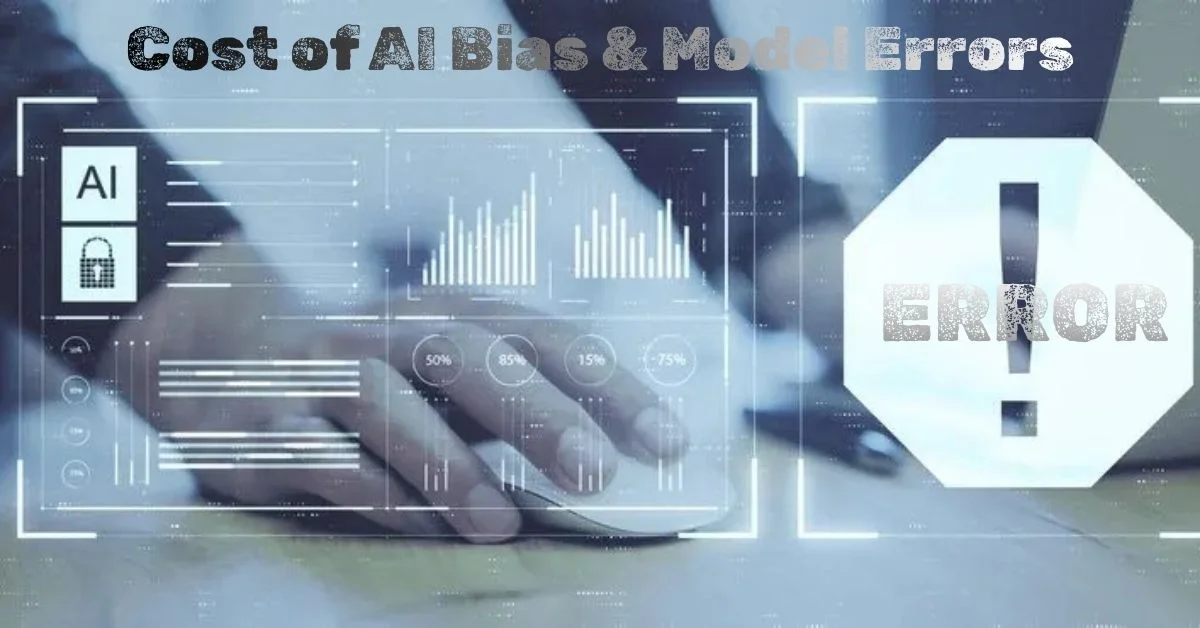
AI bias and model errors are often treated as separate problems. Bias sounds like an ethics issue. Model error sounds like a technical issue. In production, both can become business losses because they change decisions at scale.
A false fraud alert can block a legitimate customer. A hiring model can rank candidates unevenly. A forecasting model can push inventory in the wrong direction. A generative AI system can produce a confident answer that creates expensive rework. The important question is not whether a model is “accurate” in general. It is which errors matter, who absorbs the cost, and how quickly the organization can detect them.
The Model Error Loss Stack
A useful way to quantify AI risk is to map each failure into a Model Error Loss Stack.
| Layer | What the error creates | Example measure |
|---|---|---|
| Decision loss | Incorrect approvals, denials, rankings or recommendations | Value of wrong decisions |
| Process loss | Manual review, rework and escalation | Hours and queue delay |
| Customer loss | Refunds, complaints, churn or service recovery | Remediation cost and retention impact |
| Compliance loss | Investigation, documentation, legal review and corrective action | External and internal response cost |
| Trust loss | Lower adoption by employees or customers | Override, abandonment and usage rates |
| Control cost | Monitoring, validation and human review needed to operate safely | Ongoing cost per decision |
This model avoids an unrealistic assumption that every error becomes a lawsuit or fine. Most model errors create smaller operational costs. A minority can become high-impact events when the decision is consequential or the error affects many people.
Accuracy can hide the error that matters most
A model can have strong overall accuracy and still fail badly for the business.
Suppose a fraud system correctly classifies 99% of transactions. That sounds excellent. But if the remaining 1% contains a large number of legitimate high-value customers incorrectly blocked, the commercial cost may be unacceptable.
The same principle applies to lending, hiring, healthcare support, security detection and other high-impact uses. Aggregate accuracy can hide differences between false positives and false negatives, or between groups with different data representation.
Before deployment, define the cost asymmetry of the decision. Ask:
- What does a false positive cost?
- What does a false negative cost?
- Which error can be reversed?
- Which error affects a person’s rights or access to an important service?
- Does the cost change across different user groups?
The threshold should be chosen from those consequences, not from a benchmark score alone.
Bias is often a system problem, not a single-data problem
Training data matters, but bias can enter at several points: problem definition, label design, sampling, feature selection, thresholds, user interface, human override rules and the way outputs are used in a workflow.
That means “we removed protected attributes” is not a complete fairness strategy. Other variables can still act as proxies, and unequal outcomes can also appear because historical data reflects unequal conditions.
NIST’s AI Risk Management Framework emphasizes mapping the context and impact of AI systems before measuring and managing risk. That is useful because fairness cannot be evaluated without understanding who is affected and what decision the model supports. See the NIST AI Risk Management Framework.

Model drift turns yesterday’s acceptable model into today’s risk
A model can pass validation and still deteriorate after launch. Customer behavior changes. Products change. Fraud tactics adapt. Economic conditions move. A data pipeline may begin sending a field with a different meaning.
Monitoring should therefore distinguish at least four things:
- data drift: the input distribution changes
- concept drift: the relationship between inputs and outcomes changes
- performance drift: decision quality falls
- workflow drift: people begin using the model in a way it was not approved for
The fourth category is easy to miss. A model can be technically stable while its business use quietly expands into a higher-risk decision.
Human review has a cost, but so does bad automation
Organizations sometimes treat human review as evidence that AI has failed to automate enough. That is too simplistic.
For low-impact tasks, near-complete automation may be sensible. For high-impact decisions, selective review can be an economically rational control.
The goal is to place human review where it has the highest risk-reduction value. Review can be triggered by low confidence, unusual inputs, high financial value, protected or sensitive contexts, conflicting evidence or a decision that is difficult to reverse.
A useful metric is review yield: how often does human review catch a material issue? If thousands of low-risk outputs are reviewed but almost none are changed, the checkpoint may be too broad. If serious errors repeatedly bypass review, it is too narrow.
Generative AI needs a different error budget
Traditional predictive models often output a score, class or forecast. Generative systems can produce open-ended text, code, images or multi-step actions. Their failure modes therefore include factual error, unsupported inference, prompt injection, unsafe tool use and retrieval from stale or unauthorized information.
For generative AI, an error budget should include:
- unsupported factual claims
- incorrect citations or source attribution
- unsafe or unauthorized actions
- data leakage
- failure to follow required business rules
- excessive human correction time
NIST’s Generative AI Profile extends its AI RMF specifically for generative AI risks and is a useful current reference for teams building controls around these systems. NIST Generative AI Profile.
Regulatory exposure depends on the use case
There is no single global rule saying every biased model produces a fine. Legal obligations depend on jurisdiction, sector, the organization’s role and the type of decision.
In the European Union, the AI Act applies a risk-based framework with obligations that vary by system category and use. Its implementation is phased, and organizations should map the current requirements to the specific system rather than relying on a generic “AI compliant” label. The European Commission maintains the current timeline on its AI Act overview.
Existing employment, consumer-protection, privacy, financial-services and anti-discrimination law can also matter even when a rule is not branded as an “AI law.”
Quantify model error with exposure, not drama
A practical risk model can be built around four variables:
Expected model-error loss = error frequency × decisions exposed × loss per error × propagation factor
The propagation factor captures whether one wrong output affects a single transaction or spreads through a workflow. For example, an incorrect recommendation viewed by one analyst has a low propagation factor. A pricing error pushed automatically to millions of records has a much larger one.
This is not an accounting formula. It is a decision model that forces teams to state their assumptions.
Run low, base and severe scenarios. Do not invent precise probabilities where evidence is weak. The purpose is to compare controls and use cases consistently.
The safest metric is often cost per corrected decision
If a system produces business value but requires review, measure how much it costs to catch and correct important mistakes.
For example:
Cost per corrected decision = total monitoring and review cost ÷ material errors detected and corrected
Compare that figure with the expected loss if those errors reached customers or downstream systems. This helps teams decide whether to improve the model, tighten the workflow, increase review or stop automating that decision.

A pre-production model risk gate
Before a high-impact AI system goes live, require clear answers to these questions:
- What decision does the model influence?
- Who can be harmed by an incorrect output?
- What are the false-positive and false-negative costs?
- Which groups or edge cases were tested separately?
- What data changes would make the validation obsolete?
- When does a person review or override the output?
- What evidence is logged?
- What threshold triggers rollback or suspension?
- Who owns the business consequence, not just the model?
This is stronger than a generic accuracy target because it connects the model to the real workflow.
Do not hide model risk inside a vendor contract
Buying an AI product does not transfer all responsibility for how the organization uses it.
Procurement should ask what evaluation evidence the vendor provides, how models are changed, which data is retained, whether customers can export logs, how incidents are communicated and whether the buyer can disable or roll back new AI functionality.
The enterprise should then run its own use-case validation. A vendor benchmark cannot measure the exact cost of a wrong decision in your process.
Final takeaway
The cost of AI bias and model errors is not one dramatic number. It is a stack of decision loss, operational rework, customer remediation, compliance exposure, trust loss and ongoing control cost.
The most useful risk program starts by understanding error asymmetry, tests affected groups and edge cases, monitors drift, places human review where consequences become difficult to reverse, and measures the cost of correcting mistakes before they propagate.
AI does not become safe because a model score is high. It becomes more governable when the organization can explain which errors matter and has a reliable way to detect, contain and learn from them.
Author
Talha Qureshi is the founder and technology writer behind ITechTrove. He covers enterprise AI, cybersecurity, cloud infrastructure, B2B SaaS and emerging technology through practical, source-based analysis.