 Skip to content
Enterprise cloud spending becomes risky when infrastructure can grow faster than the organization can explain its value. Flexible provisioning is one of the cloud’s advantages, but the same flexibility can create persistent waste when resources have no owner, workloads are oversized, data moves unnecessarily or commitments are purchased without reliable demand forecasts.
The problem is not simply a large cloud bill. A large bill can be justified by a valuable workload. The real risk is unexplained, unallocated or structurally inefficient spending that continues to grow without a clear business outcome.
The Enterprise Cloud Spend Risk Map
| Risk | How cost grows | Leading indicator |
|---|---|---|
| Overprovisioning | Resources are sized for theoretical peaks rather than measured demand | Low sustained utilization with no documented resilience reason |
| Idle resources | Temporary environments, disks, snapshots and services remain active | Spend with no recent usage or owner |
| Weak allocation | Shared costs cannot be tied to products or teams | Large unallocated cost pool |
| Data transfer | Cross-region, internet and inter-cloud traffic accumulates | Transfer cost grows faster than workload volume |
| Commitment mismatch | Discount commitments exceed stable usage | Low commitment utilization or coverage |
| Multi-cloud duplication | Similar tools and controls are purchased in several environments | Overlapping services with no resilience or regulatory justification |
| Observability growth | Logs and metrics are retained at high volume without policy | Telemetry cost grows independently of incident value |
| AI and GPU workloads | Expensive compute, endpoints and experiments remain active | High spend without a named use case or review date |
1. Weak Ownership Turns Technical Usage Into Financial Blind Spots
Every material cloud workload should have a business or product owner and a technical owner. Without ownership, finance can see the charge but cannot answer why it exists, while engineering may understand the resource without knowing its budget impact.
Tagging and account structure help, but labels alone are not governance. A useful ownership model connects a resource or workload to:
- a product, service or internal capability
- a responsible team
- an environment such as production, development or test
- a cost center or business unit
- a review date
- a measurable operating purpose
When a significant cost cannot be mapped to those fields, it should enter a review queue rather than remain a permanent shared expense.
2. Overprovisioning Is Usually a Measurement Problem
Cloud resources are often sized conservatively during launch and never revisited. That creates excess capacity that becomes invisible because the application still performs correctly.
Rightsizing should use real workload evidence across CPU, memory, storage, network, latency and peak-demand patterns. Average CPU alone is not enough. A database may appear underused while memory, IOPS or recovery requirements justify its size.
The objective is not to push every resource toward maximum utilization. It is to remove capacity that has no reliability, performance or business justification.
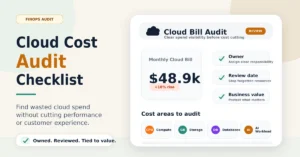
For a step-by-step review process, see the cloud cost audit checklist.
3. Idle Resources Create the Easiest Form of Recurring Waste
Some cloud waste is architectural. Idle-resource waste is simpler: the organization is paying for something that is no longer doing useful work.
Common examples include abandoned test servers, unattached storage, stale snapshots, duplicate load balancers, old migration environments, development clusters left running continuously and proof-of-concept services that were never shut down.
Automated schedules and expiration policies are useful for temporary environments. Deletion should still require ownership checks because an unfamiliar resource may support a critical dependency that is poorly documented.
4. Poor Cost Allocation Hides Which Products Are Economically Healthy
A cloud bill can be accurate while management reporting is misleading. If shared infrastructure is not allocated consistently, one product can appear more profitable while another absorbs common platform costs.
Organizations generally use some combination of showback and chargeback. Showback gives teams visibility into the cost they create. Chargeback goes further by assigning that cost to a budget or business unit.
Allocation does not need to be perfect on day one. It needs to be transparent and repeatable. Document the rule for shared services, platform teams, network costs, observability and common security tooling so finance and engineering calculate product economics from the same assumptions.
5. Unit Economics Are More Useful Than Total Spend Alone
Total cloud spend can rise while efficiency improves if the business is processing more transactions, serving more customers or running more valuable workloads. That is why executive reviews should include a unit-cost metric alongside the monthly bill.
Examples include:
- cloud cost per active customer
- infrastructure cost per transaction
- cost per API request
- cost per processed document
- cost per analytics job
- AI infrastructure cost per successful workflow
The right unit depends on the business model. A useful unit should connect technical consumption to an outcome leaders already understand.
6. Data Transfer Can Become an Architecture Tax
Network cost is easy to underestimate because developers often think about compute and storage first. Cross-region replication, internet egress, analytics exports and movement between cloud providers can become material at scale.
Review the path data takes through the architecture. Ask whether each transfer is required for latency, availability, compliance, analytics or resilience. If the movement has no clear purpose, the architecture may be paying a recurring tax for historical design decisions.
This issue becomes more important in multi-cloud environments. Using several providers can reduce concentration risk or meet specific technical requirements, but it can also multiply transfer charges, tooling and operating complexity. The ITechTrove comparison of hybrid cloud and multi-cloud covers those tradeoffs in more detail.
7. Commitments Reduce Price Only When Demand Is Stable
Reserved capacity, savings plans and committed-use discounts can materially reduce unit cost for predictable workloads. They can also convert a flexible cloud expense into a financial commitment that no longer matches actual demand.
Before purchasing a commitment, measure:
- baseline usage that has remained stable over time
- expected product or workload changes
- existing commitment utilization
- coverage of eligible usage
- the cost of being wrong if demand falls
A discount applied to unnecessary infrastructure is still unnecessary spending.
8. Observability Costs Need Their Own Retention Policy
Logs, traces and metrics are essential for security, reliability and incident response. They can also grow indefinitely when every data source is retained at maximum detail.
Classify telemetry by purpose. Security evidence, production troubleshooting, performance analytics and temporary debug logs may require different retention periods and storage tiers. High-cardinality metrics and verbose application logs deserve particular attention because their cost can rise quickly.
The goal is not to reduce visibility. It is to retain the evidence the organization needs at a cost that matches its operational value.
9. AI Workloads Add a New Layer of Variable Spend
AI systems can create cost through GPU capacity, model inference, vector databases, embeddings, data pipelines, storage, tool calls and repeated agent actions. A proof of concept can become a permanent bill even when the experiment never reaches production.
Every material AI workload should have:
- a named owner
- a budget or spending limit
- a measurable business outcome
- a cost-per-successful-task metric where practical
- a review date
- a shutdown rule if the experiment fails to create value
This turns AI cost from an infrastructure mystery into a product or workflow decision.
10. Security and Compliance Can Create Hidden Cloud Operating Costs
Security is not a cost category that should simply be minimized. Identity controls, encryption, backups, logging, vulnerability management and recovery capacity are part of operating a trustworthy cloud environment.
The financial risk appears when controls are duplicated, poorly designed or added reactively after architecture decisions have already been made. A misconfiguration can also create incident-response, remediation and downtime costs far larger than the original infrastructure charge.
For that risk path, see the analysis of the financial consequences of cloud misconfiguration.
11. Disaster Recovery Has a Cost Before and After an Outage
Resilience requires deliberate spending. Replication, standby capacity, backups and recovery testing all cost money. The mistake is to maintain recovery infrastructure without testing whether it can meet the required recovery time and recovery point objectives.
Review disaster-recovery cost together with business criticality. A low-value internal application does not necessarily need the same recovery architecture as a revenue-critical customer platform. Matching recovery design to impact prevents both under-protection and unnecessary duplication.
Use FinOps as an Operating Model, Not a Monthly Report
The FinOps Foundation frames cloud financial management as collaboration among engineering, finance and business teams. That operating model is important because no single team has enough context to optimize cloud spending safely.
Engineering knows how workloads behave. Finance understands budgets, forecasts and commitments. Product and business owners understand whether the workload creates customer or operational value.
A monthly report that arrives after the money is spent is useful for accounting but weak for control. FinOps becomes more effective when cost information is available during architecture, deployment and product decisions.
An Executive Cloud Spend Risk Register
Leadership does not need a list of every resource. It needs a concise view of material financial risks and who owns them.
| Risk item | Evidence | Owner | Decision |
|---|---|---|---|
| Unallocated shared spend | Percentage of bill with no product or team mapping | FinOps or platform lead | Improve allocation model |
| Overprovisioned production | Utilization and performance evidence | Engineering owner | Rightsize or document capacity need |
| Unused commitments | Commitment utilization | Finance and cloud lead | Adjust future purchasing |
| Rapid AI cost growth | Cost per workflow and budget variance | AI product owner | Optimize, cap or stop |
| Multi-cloud duplication | Overlapping services and tooling | Architecture owner | Consolidate or document justification |
Leading Indicators to Review Every Month
- total cloud spend versus forecast
- percentage of spend allocated to a named owner
- unit cost for the most important workloads
- idle-resource spend
- commitment utilization and coverage
- data-transfer growth
- observability cost as a percentage of infrastructure cost
- AI and GPU spend by use case
- new high-cost services with no review date
- cost anomalies that remained unresolved after the reporting period
For forecasting specifically, see Why Cloud Cost Forecasting Fails in Large Organizations.
A 30-Day Cloud Spend Control Plan
- Week 1: map the top 80 to 90 percent of spend to services, teams, owners and environments.
- Week 2: investigate idle resources, major utilization gaps, data-transfer growth and commitment usage.
- Week 3: define unit-cost metrics, allocation rules, budget alerts and review thresholds for the largest workloads.
- Week 4: assign remediation owners, document exceptions and establish a monthly finance-engineering review.
The aim is not a one-time bill reduction. It is to create a system in which unexpected growth is identified early and every material cost has an accountable explanation.
Conclusion
Enterprise cloud spending risk is a governance and unit-economics problem as much as an infrastructure problem. Cost rises become dangerous when ownership is unclear, usage is poorly measured and financial decisions are separated from architecture decisions.
Organizations that combine workload visibility, ownership, unit-cost metrics, realistic forecasting and FinOps discipline can distinguish valuable cloud growth from structural waste. That makes optimization a continuous operating practice instead of an emergency response to a surprising invoice.
Author
Talha Qureshi is the founder and technology writer behind ITechTrove. He covers enterprise AI, cybersecurity, cloud infrastructure, B2B SaaS and emerging technology, focusing on practical guides, analysis and source-based reporting.











1 thought on “Enterprise Cloud Spending Risks That Escalate Operating Expenses”